Category : UX/UI Design

UX/UI Design

The role of Information Architecture in creating richer user experiences

In a world where everything that a user needs is just ‘an app away,’ offering delightful User Experiences can be the differentiator for businesses amongst the myriad of options, that consumers might have. The fact that 88% of people are less inclined to return to a site after a bad UX makes it a key factor for businesses to retain customers. A good UX is not just critical for customer engagement and retention but it also drives business value, according to a study by Forrester, every $1 that’s being invested in UX returns $100.

The saying ‘well begun is half done’ is aptly well-suited in this context of creating unique, intuitive, and engaging user experiences that simplify the user’s journey across the platform, and building Information Architecture (IA) is the first step towards achieving this goal.

An IA is a blueprint that guides your team while designing the UX for any digital platform. It is in fact one of the most valuable and necessary aspects while embarking on the journey of creating digital solutions. It is a collaborative task often shared between the design, development and engineering teams.

In this article, we will learn about information architecture and how it functions as a backbone while crafting user experiences for your products.

What is an information architecture (IA)?

Information architecture can be defined as a method of organizing, structuring, and labeling the content of a website, web or mobile applications.

The ultimate goal of an IA is to establish an easy and logical decision-making process for the end users of designed product.
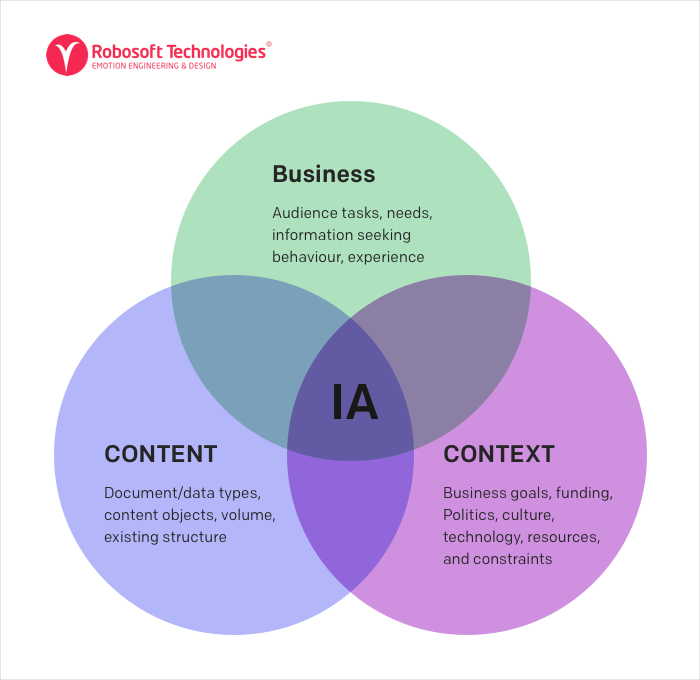
Elements of IA

Date source – 3 Elements of IA

The art and science of creating Information Architecture

Information architecture has roots in both library science and cognitive psychology.  Let us take a moment to understand these terms individually.

Library science

Libraries have always been associated with the practice of information science. Library science is the study of how to categorize and catalog information resources. The two defining traits of library science are:

  1. Categorizing – defining things by similarity
  1. Cataloging – creating metadata and assigning it to content in order to find it again in the future

Cognitive psychology

Cognitive psychology is the study of how our minds work —  what mental activities take place in our brain and what different factors influence our attention. Majority of the UI/UX design rules we have today have roots in cognitive psychology. Information Architecture uses some elements of cognitive psychology to define the way information should be structured.

Here are a few key elements of cognitive psychology that are most valuable for IA
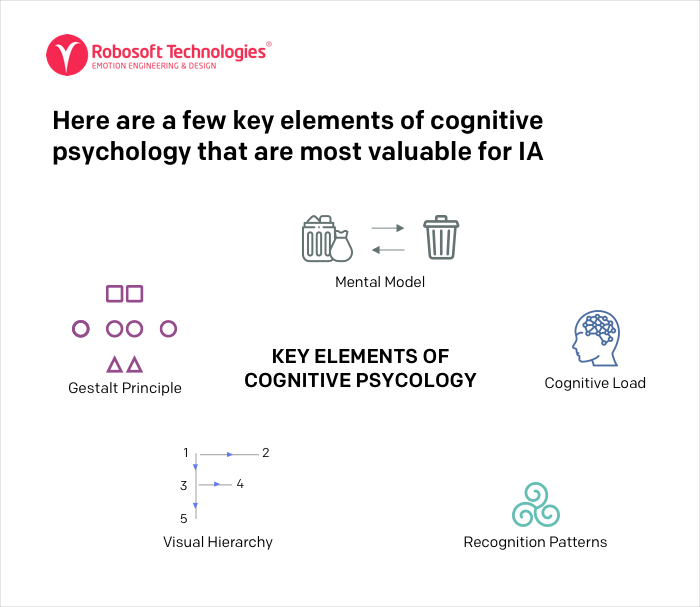
key elements of cognitive psychology

Data source – Elements of cognitve psychology

Gestalt principles: Gestalt principles explore users’ visual perception of elements in relation to each other. They show how people tend to unify visual elements into groups according to their similarity, continuity, or closure. It focuses on good figure, proximity, similarity, continuation, closure & symmetry.

Mental models: It is the users’ perception about certain things based on their past experiences. For e.g. it could be expecting the user to close a particular website/app window on clicking the button represented by a cross in the box.

Cognitive load: Cognitive load is the amount of information that a person can process at any given moment.

Recognition patterns: People visiting a website or using a mobile app expect to see certain features associated with a specific product. Designers apply various recognition patterns to make the interaction familiar.

Visual Hierarchy: Visual hierarchy is directly related to content readability. One of the essential points to consider for architects is scanning patterns — before reading a page, people scan it to get a sense of interest. The most common scanning patterns are F and Z patterns.
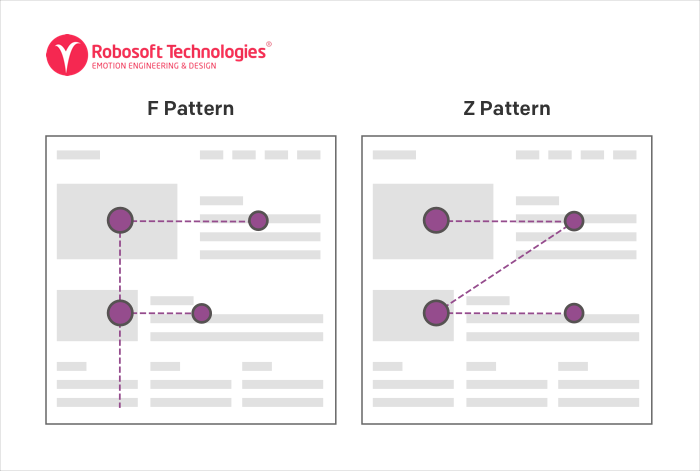
The most common scanning patterns are F and Z patterns

We derive most important components of the information architecture from the understanding of the library science and the cognitive psychology. Let us understand what these components are and how do they help in shaping up the entire information architecture.

Components of information architecture
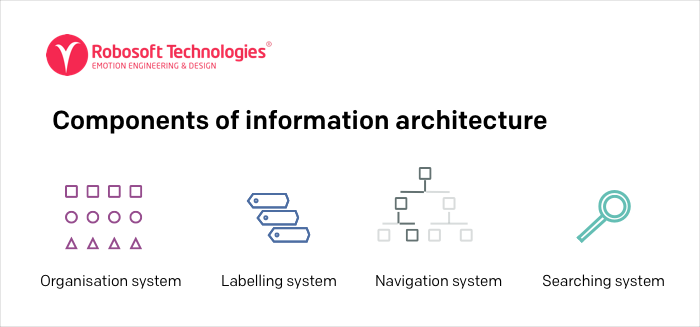
Components of information architecture

Components of IA

Information architecture is comprised of 4 components –organization system, labeling system, navigation system and search system

Organization systems Categorization of information, e.g., by subject or chronology.

Labeling systems Representation of information, e.g., scientific terminology (“Acer”) or lay terminology (“maple”).

Navigation systems How users browse or move through information, e.g., clicking through a hierarchy.

Search systems How userssearch for information, e.g., executing a search query against an index.

Types of Navigations in Information architecture

Hierarchical Navigation – Making one choice per screen until the user reaches the destination
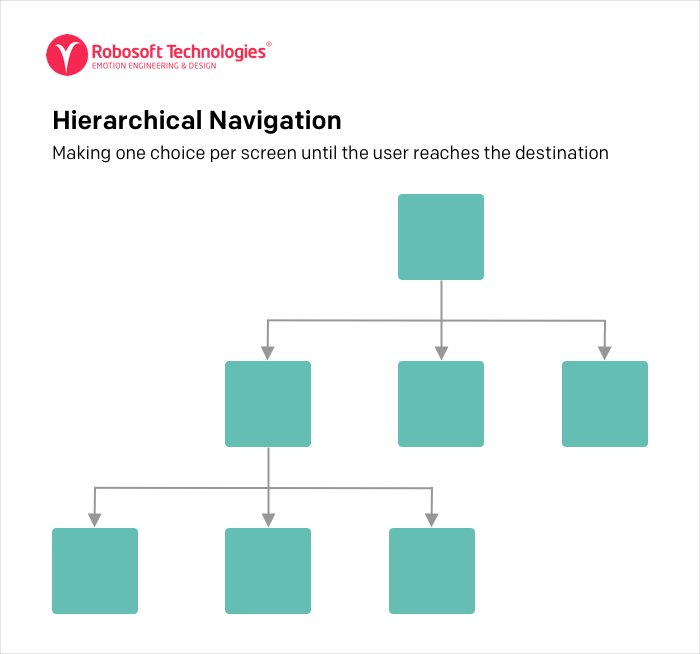
Hierarchical Navigation

Flat Navigation – Switching between multiple content categories
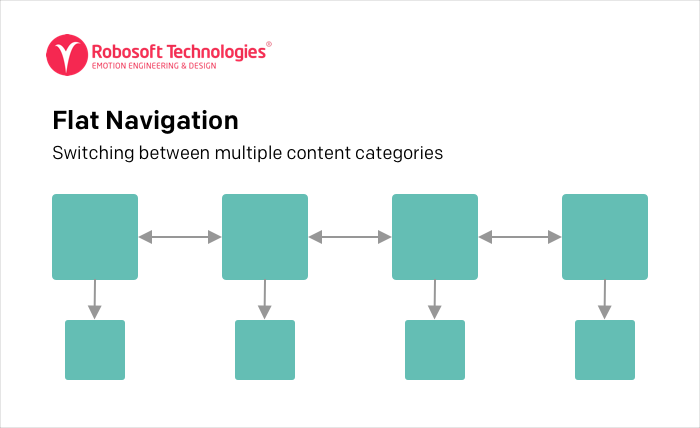
Flat Navigation

Content Driven Navigation – Moving freely through the content or the content itself defines the navigation
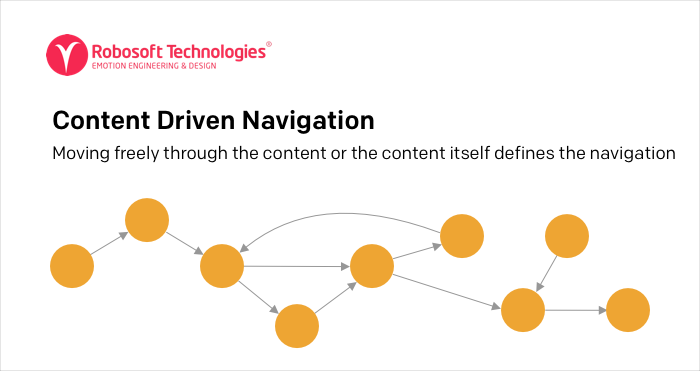
Content Driven Navigation

Now that we have the fair understanding of the Information Architecture, let us look at how to build one.

How to build an Information Architecture

The structure of an IA is based on the requirements of the project and the iterative nature of the design. It may vary from project to project. IA forms a firm base and supports the various design changes that may be done throughout the progress of the project.

Before defining the information architecture, the first step is to develop a supportive document. Based on the acquired business knowledge and the understanding of the users’ pain points. With these points in mind, adocument consisting of information like company goals, user goals, user personas and competitor analysis, etc. is created.

The process of designing an Information Architecture:

To define the information architecture we will follow a 5 step process.

1. Group the content

In this phase, we sort the content and group it under different umbrellas and define the content set.

In case of a redesign project, revisiting the entire structure and determining which information sets to keep and which ones to get rid of in addition to deciding where new content is required is the first step.

Card sorting is one of the most effective & widely used UX tool for content grouping
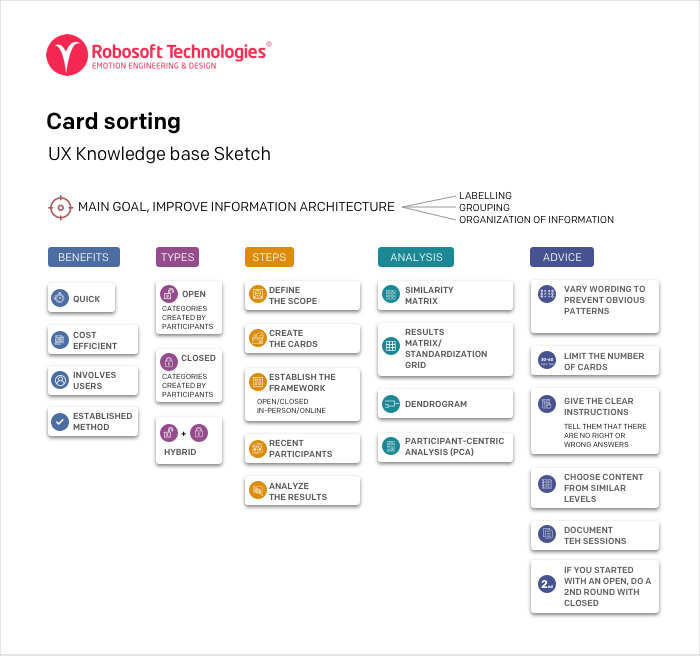
Group the content

Data source

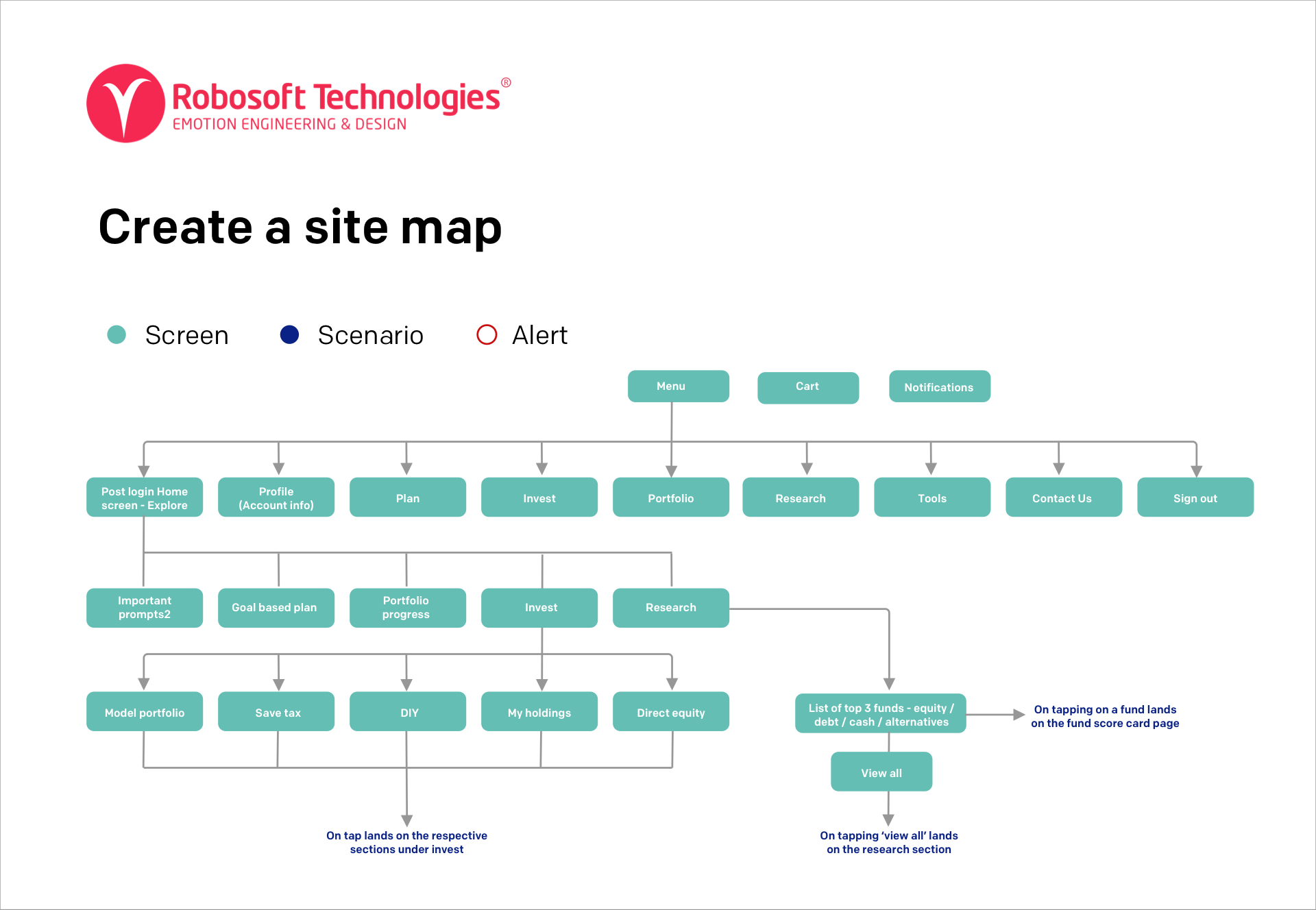
2. Create a site map

High Fidelity App Map for an Investment App

High Fidelity App Map for an Investment App

In this phase, the user goals and the purpose of the digital platform is defined. Post which the user journeys with different sets of tasks are created.

The user journeys helps in understanding the movement of the users on the digital platform and the interlinks between the pages.

3. Outline the navigation structure

The navigation structure is created based on the business understanding. Any of the navigation types mentioned earlier in the article can be used as a foundation and the entire structure can be built on it.
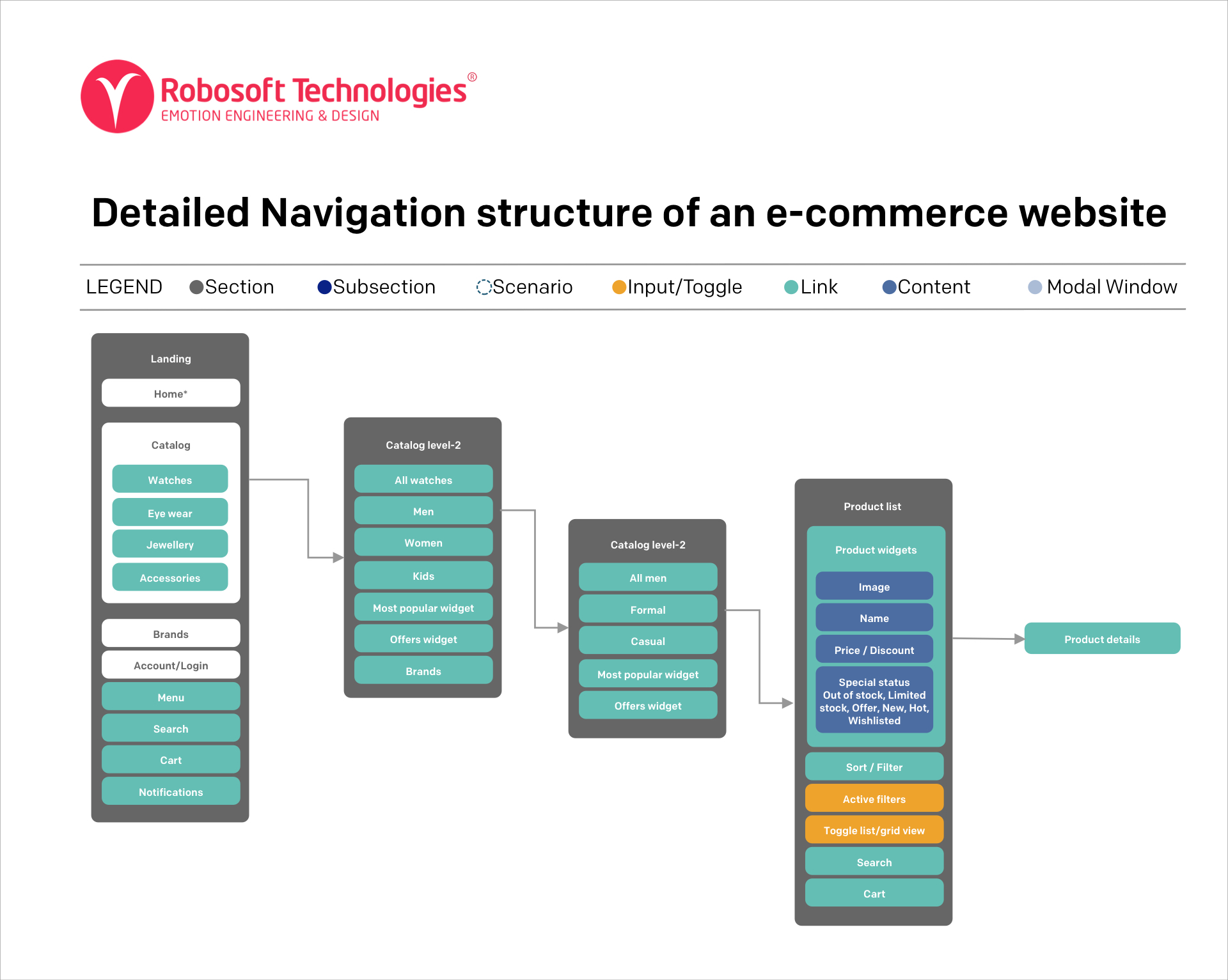
Detailed Navigation structure of an e-commerce website

Detailed Navigation structure of an e-commerce website

4. Refine content labels

In this stage, the content is labeled according to its purpose. These labels are linked to create the structured categorisation, consisting of sections, sub-sections, links, toggles etc.
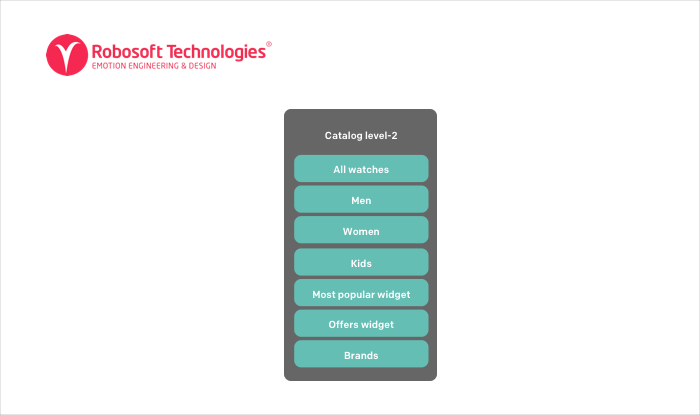
Precise and easy to understand content Labels for the catalog level -2 Section of e-commerce app

5. Create wireframes and conduct usability test (Writing Scenarios)
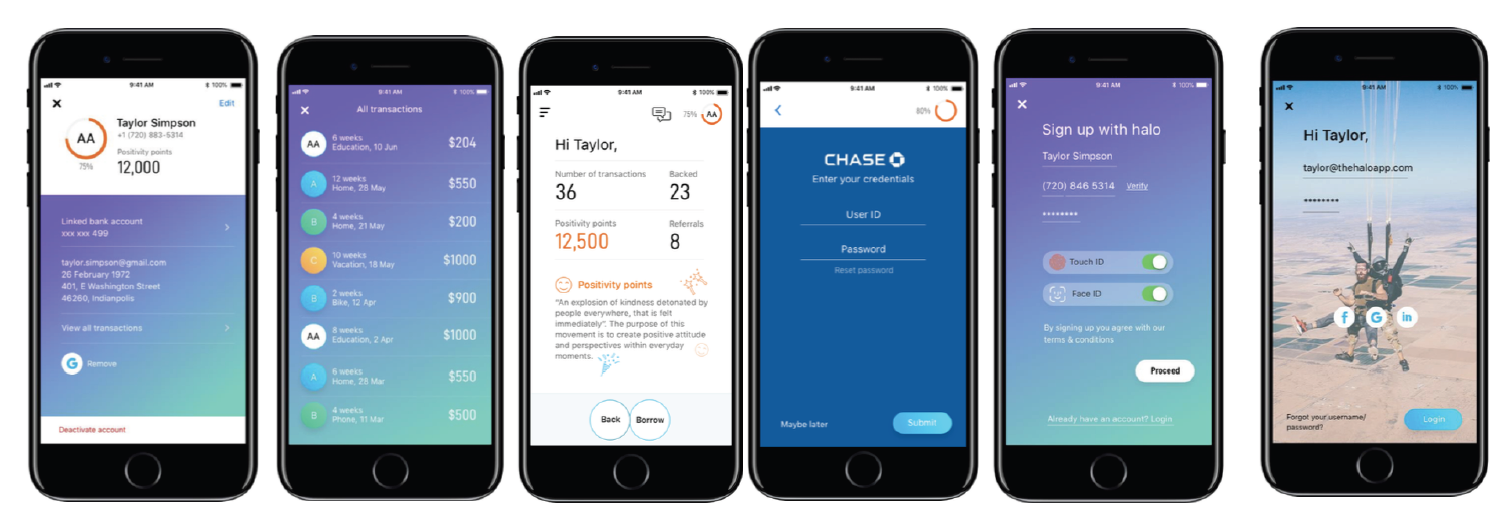
Wireframes created for an app to test the journey for the proposed IA

Wireframes created for an app to test the journey for the proposed IA

It is good practice to test out the information architecture early-on in the project and make changes as it progresses. Hence in this stage, user scenarios are written. Post which the wireframes are tested with these scenarios.

This process is critical to help understand user pain points and design failures. We can then iterate the design as required.

6. Defining areas for analytics integration. (Plugging in the analytics)
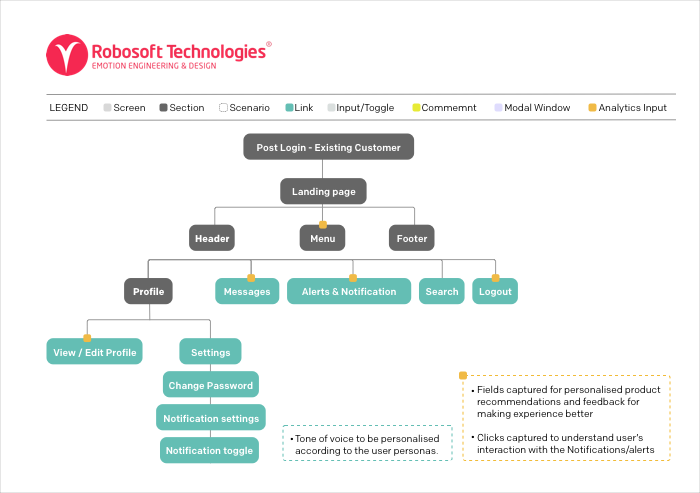
Plugging in the analytics

Example of an app map created for insurance company showing the analytics plugins

Analytics plays an important role in creating user journeys. This phase will help in identifying the focus areas of the users, the functionalities they will use most, and their pain points. This becomes a precursor for plugging in analytics to the digital platform.

Also this data comes in handy for future iterations as it can be used as a guide and changes can be made to the design in order to solve the problems and improve the user  experience. Hence, once the architecture is created, the decision can be made based on the goals of analysis and select tools as per requirements

In conclusion, Information Architecture is an integral part of an experience design process. A well structured IA is a powerful tool that ascertains methodical and easy navigation through a digital platform and ensures a seamless flow for content discovery. The nature, levels, and detailing of the architecture can vary according to the project. However, creating an  IA is a must for every experience designer and it is a critical step before embarking on the design journey.

Read More
UX/UI Design

The coming glut of online delivery apps: 5 take-aways to deliver the competitive edge in UX

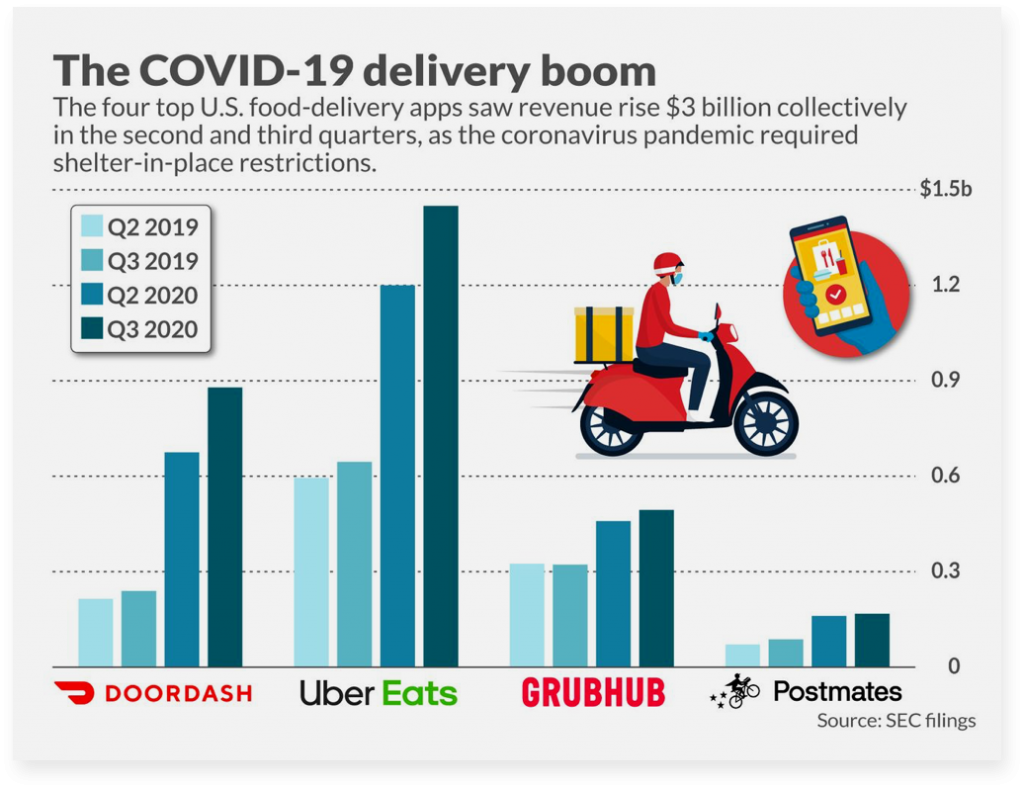
The global COVID-10 pandemic disrupted our lives in a manner we never imagined or prepared for. As is obvious, visits to restaurants, shopping malls, multiplex theatres all come down drastically. According to The National Restaurant Association, more than 110,000 restaurants in the U.S. closed for business in 2020. On the other hand, the need for social distancing, safety concerns, and lockdowns resulted in a steep growth for delivery services like DoorDash and Uber Eats which grew by more than double in 2020

Even outside of food delivery, ‘online delivery ‘of almost everything has become a part of the new normal. In April this year, Amazon reported an increase of 220 percent in its profit compared to the same period last year.

Source

Prior to the COVID-19 outbreak, e-commerce and food ordering through mobile apps were common in many countries. However, the in-store purchase was preferred in some categories. According to Nielsen, only 4% of grocery sales in the United States came through online channels last year. In March 2020, Instacart, Walmart Grocery, and Shipt have seen surges of 218%, 160%, and 124% respectively in the number of downloads compared to the previous month. The urge to change habits is also reflected in new demographics (e.g. those above 60) opting for online shopping.

Many believe that it is not a temporary phenomenon but a permanent change in behavior impacting grocery, pharmacy, food, and other industries. Beyond just a web or app design, business models are likely to be affected. Setting up of ‘dark stores’ – outlets that look like supermarkets but closed for customers and geared to be hubs for online delivery are a reality. Mini automated fulfillment centers at the back of large stores, with some even using robots, are getting traction. Stand-alone restaurants and supermarkets will face a tough situation compared to the consolidation possibilities of a brand of chains – e.g. Pizza Hut, KFC, Burger King, etc.

At Robosoft, we are seeing a surge in inquiries for digital solutions for online delivery in the US and other geographies. Several enterprises are likely to create native apps and websites to cater to this demand leading to a surfeit of such experiences. Enterprises are already battling issues such as app fatigue, poor user retention, and lack of brand loyalty. How can they maintain a competitive edge? Here are a few pointers:

Address the concerns on safety and hygiene upfront

The first step towards creating a compelling digital experience is to understand the consumer pain points through empathy and craft a solution that intuitively solves that problem. In these times of anxiety, understanding customer needs, their mindset, motivations, and barriers are even more critical. Design Thinking workshops, even held remotely, can help enterprises gain valuable insights into the consumer mindset. Consumers need the reassurance of safety precautions undertaken by the brand – in any form of delivery service. A norm of the remote-working era – over-communicate is worth following as contactless delivery, safety precautions taken by the staff need to be visually highlighted.

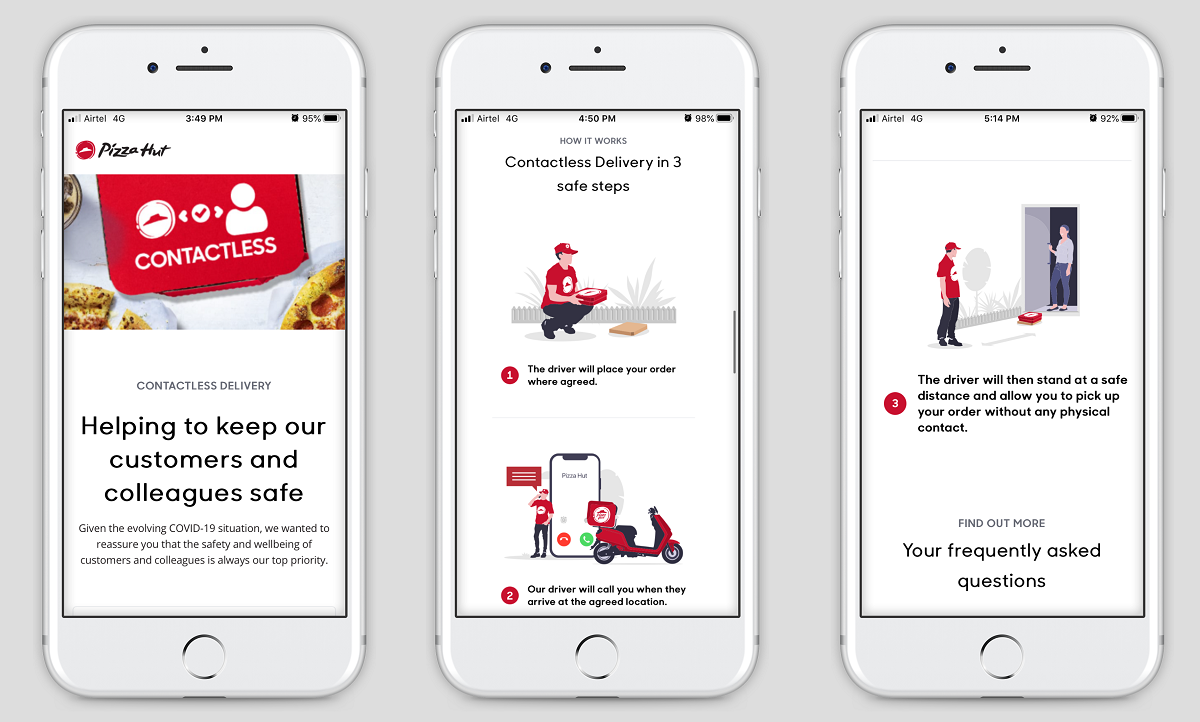
Clear, bold, reassuring message from Pizza Hut on their website.

Clear, bold, reassuring message from Pizza Hut on their website.

Details of safety precautions followed by Pizza Hut mentioned on their mobile app for customer reassurance.

Image source

Like most delivery apps, Postmates offers contact-free delivery choices. But they also encourage customers to report if their delivery person appears unwell. The company has also set up a Fleet Relief Fund to help employees with COVID-19 medical expenses.

The Kroger app added a designated FAQ section for COVID-19, which is explicit for users to look for COVID-19-relevant answers.  Walmart puts COVID-19 updates at the top of their shopping page. Users can tap and learn what Walmart is doing to provide a safe shopping environment. 

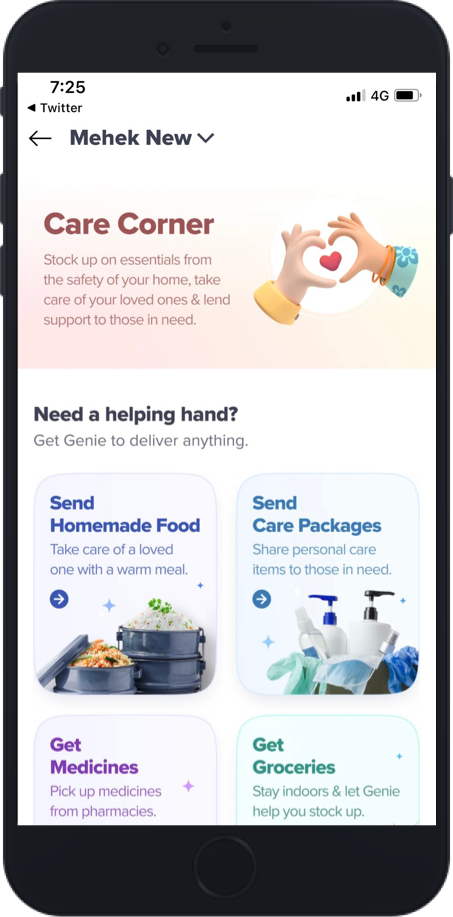
Swiggy a leading delivery app from India, recently added a ‘Care Corner’ feature in their app. It is a dedicated section within the app around COVID-19 offering users options for sending home-cooked food, sending care packages, getting medicines and groceries picked up.


The Care Corner section on Swiggy’s app

Be honest about the constraints of the new normal

During the early days of lockdown, supermarkets were overrun and shelves emptied by people stocking up supplies. E-commerce apps could not sell several non-essential products and even the essentials were delayed in terms of delivery. While consumers may be irked by such developments and even express their disappointment, deep down they’d understand that these are extraordinary circumstances and cut some slack for their favorite brands. However, consumers would rather prefer an attitude of ‘under-promise and over-deliver’ in these times and also likely to be more forgiving of snafus. So information about delayed turnaround times, unavailability of stocks, price surges if any, and replacement options must be conveyed upfront and not as unpleasant surprises at the end of a purchase process.

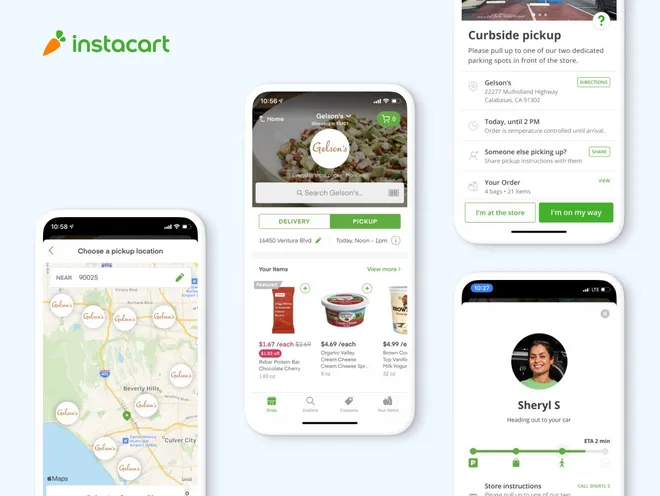
Details of pickup locations, product availability, and order status on the Instacart mobile app.

Put customers in control with a choice of delivery and technology

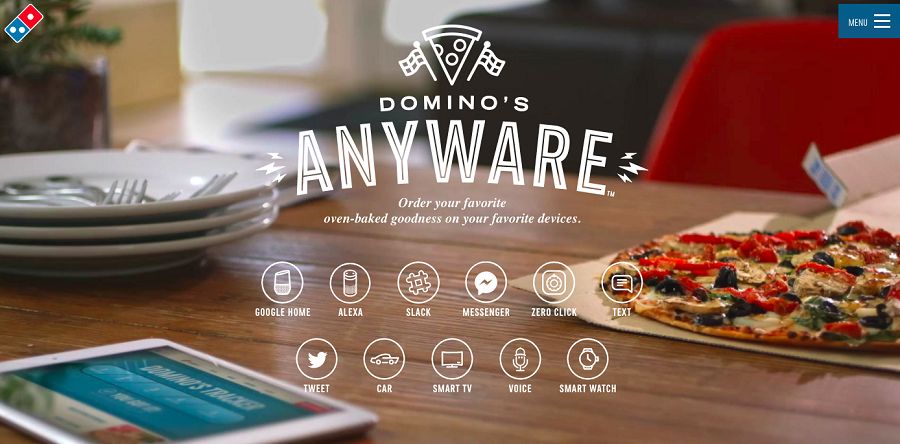
Now more than ever, customers would appreciate the simplification of processes. They already have enough to deal with at home. So any simplified process – from ordering through voice-enabled speakers, messenger platforms or a smartwatch, virtual trial of a dress (for a fashion e-commerce brand), re-order of previously ordered medicines, offering a subscription service can go a long way in feeling that’s one less weight off their shoulders. Delivering products at the chosen time by the consumer, option of curbside pickup are also examples of putting the consumer in control.

Domino’s makes it easy for its customers to order from any device

Domino’s makes it easy for its customers to order from any device

Online Delivery

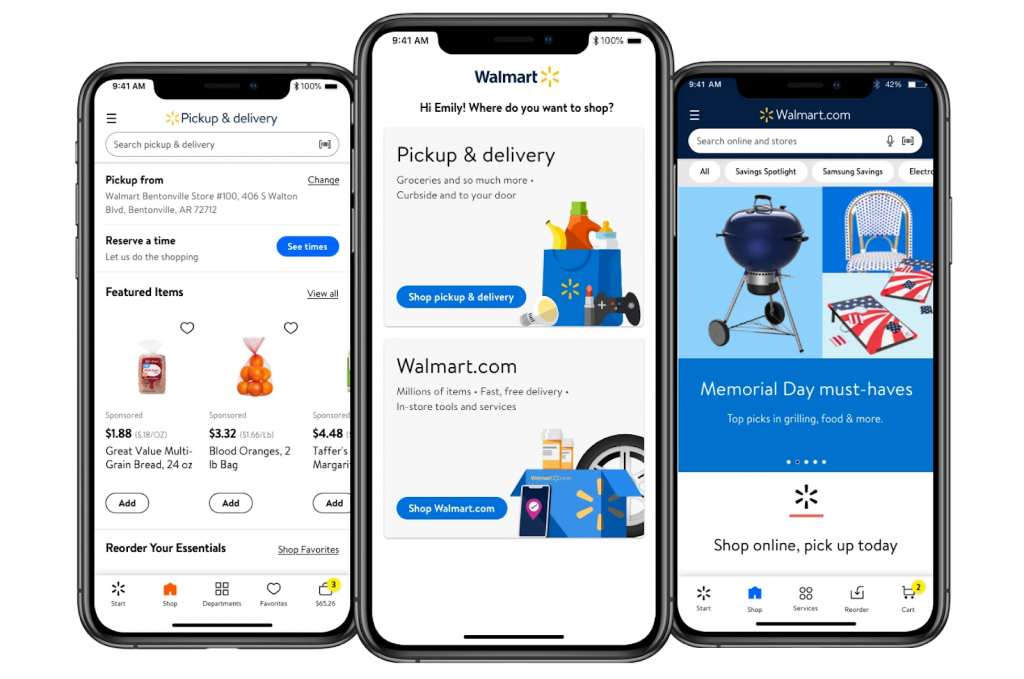
Shoppers can order essentials and non-essentials items in the same purchase on the Walmart app for curbside pickup or delivery.

Image source

Aid product discovery: use a recommendation engine to anticipate needs

The nature of the anxiety and concern for taking precautions can make consumers unsure of all that they need to stay safe. For example, grocery shopping apps can aid consumers by highlighting immunity-boosting products. Food delivery apps can add product badges which could highlight nutritional information or the number of orders in the past hour – giving some sort of assurance of making a safe choice. The role of a Recommender System is at the core in recommending items and driving customer conversion by auto-suggesting the right product to customers based on needs and behavioral data. Amazon is known for putting it to great use – 35% of Amazon.com’s revenue is generated by its recommendation engine.

Such systems get better over time which subliminally cues to the user that this brand understands me and my tastes. It helps in building loyalty and improving the average ticket size of orders.

Beyond transactions, offer relevant content for engagement or information

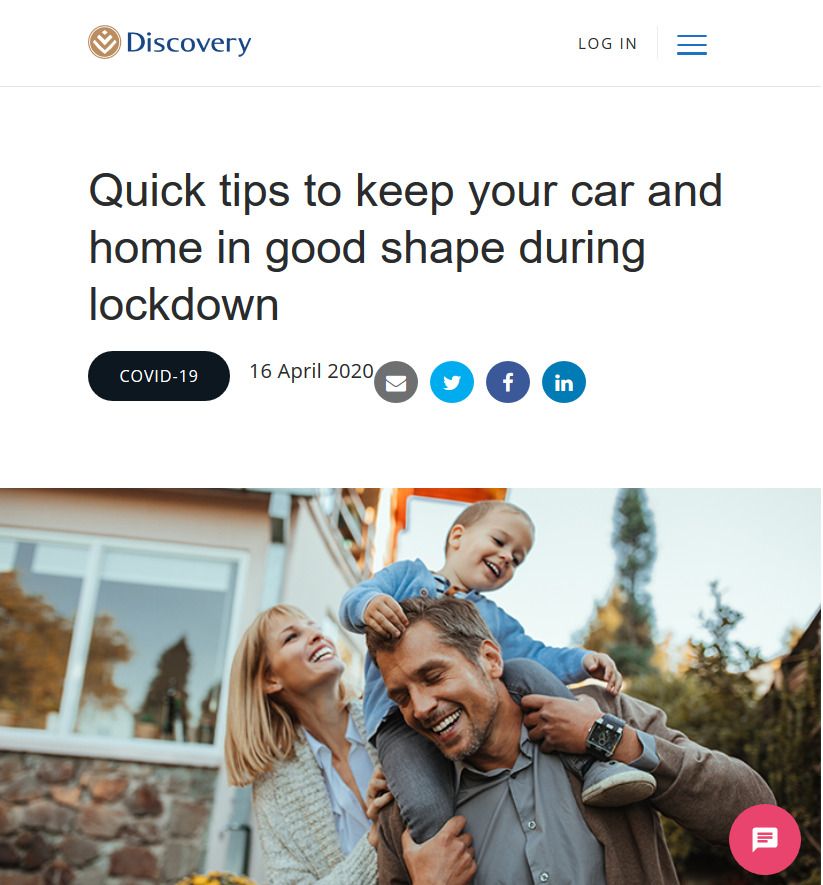
Aside from assurances of safety, there is plenty of scope to create engagement through relevant content. Food delivery apps such as Zomato have already integrated recipe videos which consumers could find valuable when the propensity to try new recipes at home is high. The insurance brand Discovery from South Africa is a great example of providing value-added content beyond merely selling a product.

Image source

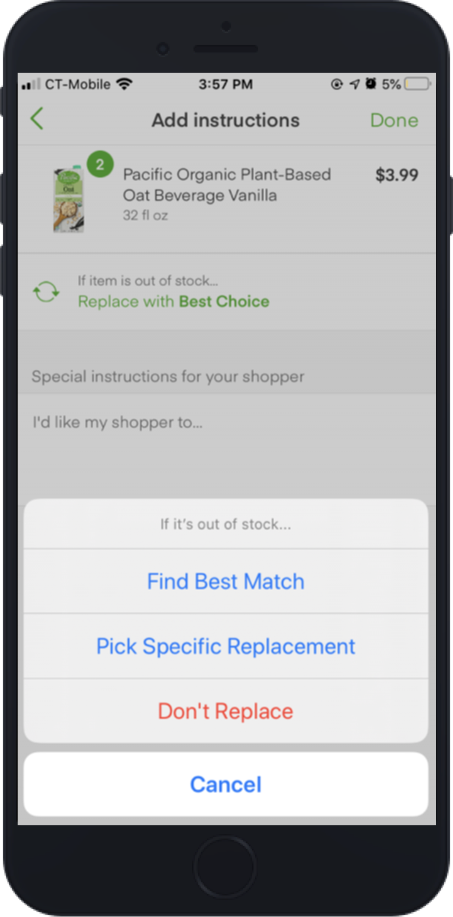
Instacart provides three options to the users if an item is unavailable:

  1. Shoppers (assigned delivery partners) can choose the best replacement for the unavailable item
  2. Users can designate a substitute item.
  3. Leave out the item when unavailable.

Instacart’s app provides three options to the users if an item is unavailable.

In the coming months and years as more and more brands adopt digital solutions and online delivery models, meaningful product-level differentiation will be difficult to achieve. The competitive edge would really lie in the positive sentiments the digital experience evokes in a consumer, thus subliminally generating brand affinity. It is an appeal to the emotional brain which drives brand purchase decisions than the rational brain. The choice of the right digital partner in the experience economy is also a key factor in providing a competitive edge to enterprises.

In one of our webinars, Mart to cart: role of digital experiences in online delivery, we discussed the evolving consumer behavior and key factors that can help delivery services in crafting great digital experiences. You can watch a recording of the session here.

Read More
UX/UI Design

The role of User Experience, Data Science and a Recommender System in improving Customer Lifetime Value

Metrics are an integral part of business success. As the management guru Peter Drucker said, ‘you can’t manage what you can’t measure’. Across B2C and B2B, enterprises and functions within them, chase their own metrics. They may see varying value in Net Promoter Score, Customer Acquisition Cost, CSAT (Customer Satisfaction), and various user engagement metrics such as MAU (Monthly Active Users) and Retention Curve. However, they are all likely to agree that Customer Lifetime Value is a meaningful and relevant KPI to indicate the long-term health of a business.

Customer lifetime value, or CLV, is a predictive performance indicator that allows you to quantify the total value of a customer if they were to form a long-term relationship with your company or brand. In simple terms, it is ‘revenue earned from a customer (annual revenue multiplied by the average customer lifespan) minus the initial cost of acquiring them’. So the incentive for enterprises is to invest in long term relationships with customers. In establishing such relationships, the quality of digital experiences is critical more than ever before in today’s world.

The 5 levers of digital innovation

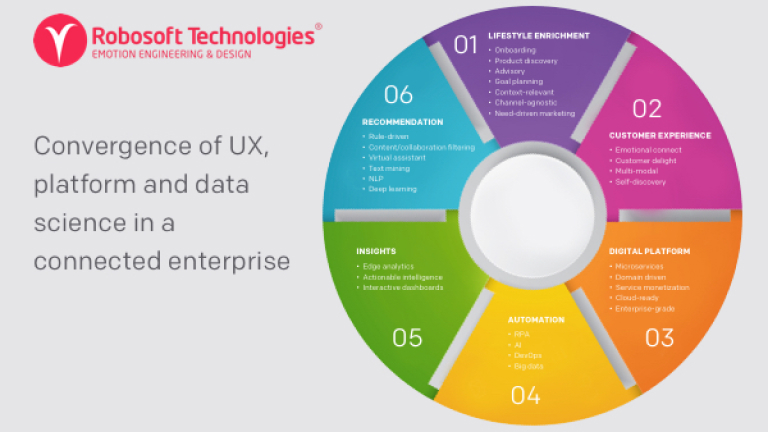
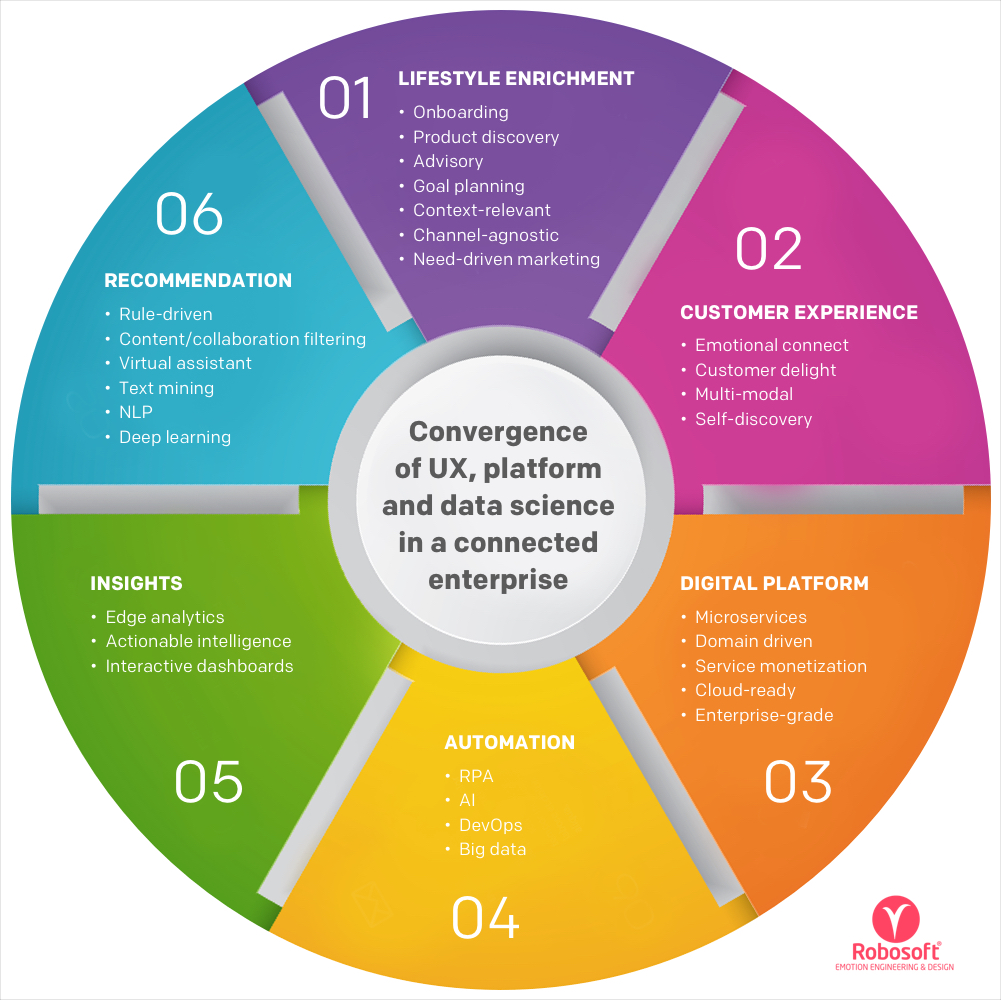
Increasingly, customers tend to base their perceptions of credibility, trust, and overall value of a brand through its digital experiences. In financial services, self-service dashboards, humanized banking, investment advisory, frictionless lending are common features which are digitally enabled. Personalized infotainment with natural language support and curated recommendations are seen in entertainment services. Similarly, across domains, enterprises can acquire segmented customers and offer a wide range of services by leveraging 5 levers of digital innovation:

Lifestyle Enrichment: With a combination of data and digital experiences, enterprises are in a position to know more about consumer needs and fulfill them at every stage in life. For example, in financial services brands can offer seamless client onboarding, personalized recommendations based on goals, advisory via a panel of experts, aggregate spend analysis, and provide tips on savings.

Recommendations to improve lifestyle such as goal planning, tracking performance of investments, providing a consolidated view of assets and liabilities, need-based promotional marketing, just-in-time recommendation, and so on are already in vogue.

Similarly, enterprises in other domains such as media & entertainment and e-commerce can use analytics and digital design to enrich their customers’ lives. The customer and relevant data should move across channels (app, web, wearables, bots, social, kiosk, branch, call center, advisor, distributor) seamlessly and securely. Such services will have to be made available on the most-preferred channel or location. While it can be challenging enterprises must remember that modern applications demonstrate many advanced characteristics that are driven by the user journey and help in addressing user needs.

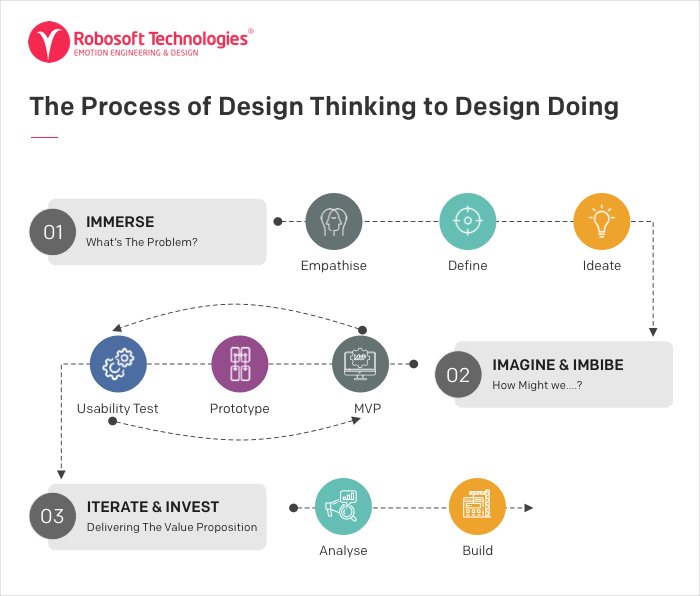
Customer Experience: Many would know Design Thinking in abstract terms but very few have applied it in practice tied to customer’s “digital body language”. Many of the apps in the market may be superficially attractive – colorful in design, but weak on purpose, interaction style, or blending cutting-edge innovations. Firstly, there must be an emotional connect with users. Next curiosity must be evoked to learn more about the services and the ease of discovery or use. Once the app crosses the chasm, customer delight and adoption happen. Design Thinking principles can help businesses understand consumers better, empathize with them, and uncover valuable insights about their stated and latent needs & pain points. But beyond just principles, Design Thinking is action – helping enterprises understand their user’s pain points, conducting faster experiments, and finally building a product that drives business results.

The process of ‘Design Thinking to Design Doing

Designers and data scientists must converge to deliver a multi-modal, intelligent, and self-learning application to millennial customers. Technologies such as facial recognition, voice, video calling can be used to address customer pain points and enhance the overall experience.

Enterprise Grade Platform: Companies shall decouple Digital from Core via Open API and monetize services usage via open-source technologies. Each business application must be architected as a collection of cloud-ready enterprise-level micro-services inter-connected to digital use-cases that can be discovered, reused, and deployed across the company. Examples include customer onboarding, multi-factor authentication, personalized UI templates, work-flow engine, product catalogue, information overlay via AR, campaign manager, video & chat conversation, virtual assistant, recommender engine, predictive analyzer and blockchain storage.

Automation: Many companies have scratched the surface on operational processes and customer interaction automation. It has been automation of mundane back-end jobs and less of a hybrid approach of humans and robot’s judgment working in tandem. Successful digital transformation must focus on enterprise productivity, contextual interactions, and real-time recommendations.

Robotic Process Automation unifies enterprise-level data to bring context to customers, integrates regulatory compliance into standard operating procedures with exception reporting, delivers always-on services, and enrich human interactions. Convergence of RPA and AI will drive revenue and profitability and cross-sell to customer’s needs. Companies must bring automation to software deployment and rollout to markets via agile practices. Automation of marketing aided by AI, geo-location intelligence, and big-data user-item profiling is a necessity.

Insights: Insights about what motivates customers and their actions can be drawn from every conversation, transaction, relationship, grievance, and social sharing.

Analytics reside at the edge-node, and can provide insights on cross-sell, product holding, customer profitability and lifetime value, attrition and loyalty, customer sentiment, channel search & usage, transactions, service requests, leads, campaigns, churn, product profitability, risk, advisory quality and more.

The real value of dashboards lies in anticipating early and accurately what your customers want and acting on it.

Convergence of UX, platform and data science in a connected enterprise

Recommender system: driving retention and engagement

The role of a Recommender System is at the core in recommending items and driving customer conversion by auto-suggesting the right product to customers based on needs and behavioral data. A robust Recommender System will discover information for customers and “what to recommend” depends on the context i.e. movies, news, shopping, loans, insurance, funds, stocks, grocery, food, etc.

A Recommender System helps the company to increase revenues by providing the most likely items that a customer can purchase or increasing the engagement by showcasing the relevant product or content. It will encompass a context-based virtual assistant capable of mining data, text, audio, video, facial, and generate automatic responses from past experience and context by applying Deep Learning principles.

There are various models and methods to build an intelligent Recommender System:

Collaborative filtering systems are based on large sets of customers who bought similar products and uses ratings or performance to make a suitable recommendation. It works usually on customer-item interactions e.g. item bought, time spent. In case of the sparseness of ratings, auxiliary information such as item-content can be used via collaborative topic regression machine learning algorithms.

Content filtering systems look at customer profile and metadata on items and creates a watch list, and also recommend similar items to customers that this customer has liked in the past. A similarity scores calculated between any two items and recommends to the customer based on profile and interest. It starts with creating item profiles for each of the items. The customer profile is created using item profiles that the customer has liked and recommends items that this customer might like based on earlier preferences.

Unsupervised Learning has no label data and no prediction of any output. It finds interesting patterns and forms groups within the data. Clustering is typically used for customer segmentation and anomaly detection.

Natural Language Processing is an area where machines learn and understand the textual data to perform tasks. NLP collects text documents, divides the sentence into words, removes stopwords, converts the text into a numerical vector, and tracks unique words as vocabulary, counts the word, and normalizes the frequency of word occurrence.

Text Mining using machine learning involves building a text classification model and uses it for predictions on text data and to predict the sentiment of any given product review. Embedding technique can compare two distinct viewer journies on similarity and predict the probability of conversion by analyzing the average time spent on each of the unique pages. This is also used in supervised ML across use cases such as next possible action prediction, converted vs non-converted, product classification.

Deep Learning provides better feature extraction from item characteristics (text, image, video, audio). Deep Learning techniques such as convolutions and recurrent neural networks allow to model the structure and order in the data for performance improvements. Collaborative deep learning allows two-way interactions between rating matrix and content. With Deep Learning, the properties of the content (images, video, text) are incorporated into recommendations. Using Deep Learning, item-to-item relations are based on a much more comprehensive picture of the product and less reliant on manual tagging and interactional histories.

In summary, companies must think of customer and user scenarios first. Be a customer-focused data-driven company and measure critical moments of interaction to cross-sell and upsell with a Wow experience! You also need a reliable long-term partner who can provide advisory on digital, design a human experience, and engineer a scalable and intelligent solution to market.

Read More
UX/UI Design

The role of usability testing in crafting digital experiences

‘Walk a mile in their shoes’ is often used an expression to convey that the design thinking process is built on empathy. As Design Thinking professionals we work on diverse projects and user needs. Sometimes, we may not be able to fully understand the motives, pressures of others’ lives.

Is it really possible for an urban male executive to truly feel how it is to be a single working mom or experience the challenges of say, working in an oil rig? I can never truly feel how it is to be a doctor using a critical patient information app, that too in the pressure of a hospital scenario. I can at best, get a peek into their lives in such a situation.

Hence, in my view, we have to understand ‘empathy’ within a context and realize its limitations as we are all shaped by our own influences, limitations, experiences and biases. That’s where Usability Testing comes into play as it can provide first hand information and insights for actual users.

Design Thinking is a holistic problem-solving framework and involves these key stages:

  • Empathize: Understand the user’s needs and problems
  • Define: Analyze the observations to define the problems
  • Ideate: Think of solution to each aspect of the problem
  • Prototype: Develop solution prototype for each aspect of the problem
  • Test: Test the product using the best solutions identified

The last phase is as critical as any other as it provides directions to product owners, strategists and designers for iterations and tweaks. Also as Design Thinking can play a role in transformation of any process – business development, operations, finance, marketing or product development it can truly impact business growth. In that context direct feedback from actual users eliminates guess work. It can also save expensive re-work in correcting flaws well before they are discovered in the marketplace.

Design Thinking Workshops to Accelerate Digital Product Development

Usability Testing: the fundamentals

The key intent of a Usability Test is to test the functionality of designs with real users in order to get a flavor of ease of use, navigation and other parameters. However, instead of leaving it all to observation and gut feel, the process involves thorough documentation and follows a process. A website, mobile app or any other digital product could be tested through this method.

There are two types of methods:

(a) In-person testing in a laboratory environment and (b) remote testing using a set of software tools. The former has an observer who is silent throughout the process and only monitors the behaviour of users and then reports the outcome. In the latter case, the screen activity, facial expressions are recorded by automated software applications.

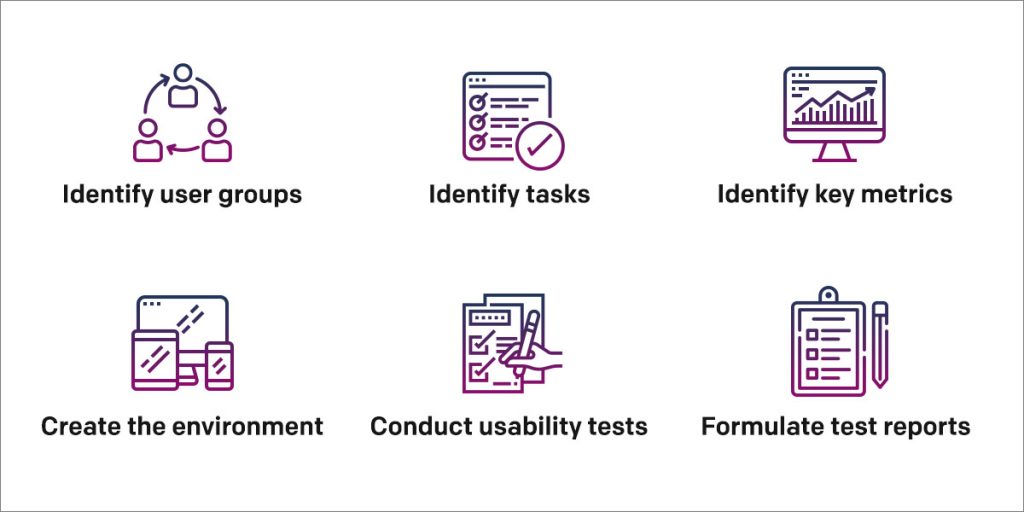
The process involves 6 broad stages:

The process involves 6 broad stages

User groups: the participant characteristics are naturally determined by the product intent. As a thumb rule, the sample size should have 9 participants per country (2 pilot, 5 regular and 2 backup).

Tasks: we need to identify key user journeys based on the objective of the app or the digital product. It could be completing a transaction for a banking product or completing a survey in a website.

An example task scenario for a restaurant table reservation app could be:

  • Finding a restaurant
    You live in Charlotte and would like to reserve a table at an upscale restaurant to mark a special occasion
  • Choosing the location
    You would like to find a restaurant which is not very far from your place of living
  • Finding types of cuisines
    Since it is a special occasion, you’d like to experiment with gourmet food, maybe an exotic cuisine which you have not tried before
  • Making a reservation
    You have identified a suitable restaurant and would like reserve a table for two
  • Receiving confirmation and viewing a reservation
    Once booked you would like to receive a confirmation alert and also view the upcoming reservation
  • Editing your reservation
    You would like to change the timing of your reservation and increase the number of guests to 4.

Metrics: we then need to create standards of measurement by which design, ease of use, efficiency and performance can be assessed. The metrics could be objective (metrics that you can measure without relying on subjective interpretation) or subjective (metrics that rely on subjective interpretation of the test participant)

Environment: this includes creating a setup to make the users feel comfortable and have all the necessary equipment at hand. These could include relevant devices, documentation for ratings and a suitable lab test location.

Usability tests: among the various methods used are Task Sheets, heat maps, observations and rating charts. A task sheet typically records the success rate (2 = Success; 1 = Needed Support; 0 = Failed) and time taken to complete a task. While Heat Maps provide a high level overview of the drop and success rate, observations add the human angle by noting facial expressions and other emotional reactions. Finally, asking the users to rate their experience while using the product gives testers and stake holders a feel of the ease of use.

Test Reports: a typical test report will include an executive summary, goal of the test, methods used, data overviews, walk-through of the results of each task and actual quotes (positive & negative) from the users.

Usability Testing is increasingly being adopted by enterprises to minimize risks and validate product features before launch. Across the globe, there are several venues, including academic institutions which host Usability Testing Labs. Moving forward, co-working spaces which offer cost savings and convenience through shared infrastructure equipment, utilities etc., could offer such services to enterprises – all it takes is a room and some basic equipment.

The benefits of Usability Testing

More than ever before, customer experience defines business success today. A poor experience on a website, mobile app or any other digital product can mean loss of a customer forever. Very rarely do customers give brands a second chance to serve them.

At Robosoft, we believe in simplifying lives through delightful digital experiences. A robust Usability Testing exercise gives enterprises a better chance of providing a great customer experience, the new battleground. It can help get validation from actual users and get a first hand feedback if it meets their expectations. It can point to barriers which need to be overcome, help point out errors and assumptions. Those working on any creation can get far too attached to it and lose a sense of objectivity – they may not see the features and navigation methods the same way as the actual user.

Usability testing is a great way to manifest empathy, which is the starting point to any Design Thinking effort. In other words, it is a small but effective investment in the larger scheme of things – well worth the effort in crafting delightful digital experiences.

Read More
1 2 3