Metrics are an integral part of business success. As the management guru Peter Drucker said, ‘you can’t manage what you can’t measure’. Across B2C and B2B, enterprises and functions within them, chase their own metrics. They may see varying value in Net Promoter Score, Customer Acquisition Cost, CSAT (Customer Satisfaction), and various user engagement metrics such as MAU (Monthly Active Users) and Retention Curve. However, they are all likely to agree that Customer Lifetime Value is a meaningful and relevant KPI to indicate the long-term health of a business.
Customer lifetime value, or CLV, is a predictive performance indicator that allows you to quantify the total value of a customer if they were to form a long-term relationship with your company or brand. In simple terms, it is ‘revenue earned from a customer (annual revenue multiplied by the average customer lifespan) minus the initial cost of acquiring them’. So the incentive for enterprises is to invest in long term relationships with customers. In establishing such relationships, the quality of digital experiences is critical more than ever before in today’s world.
The 5 levers of digital innovation
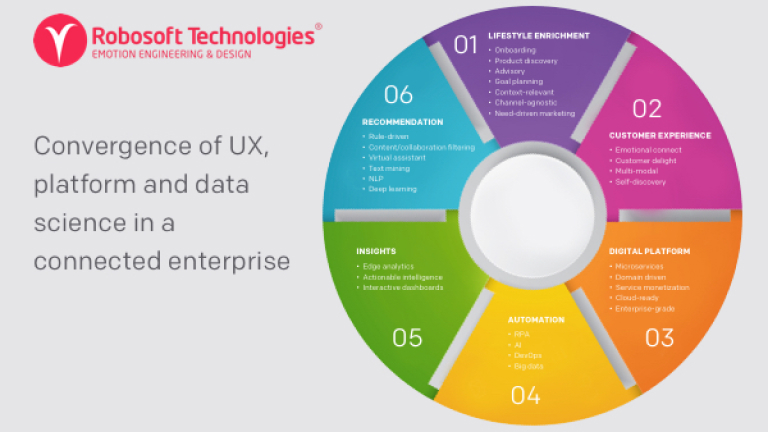
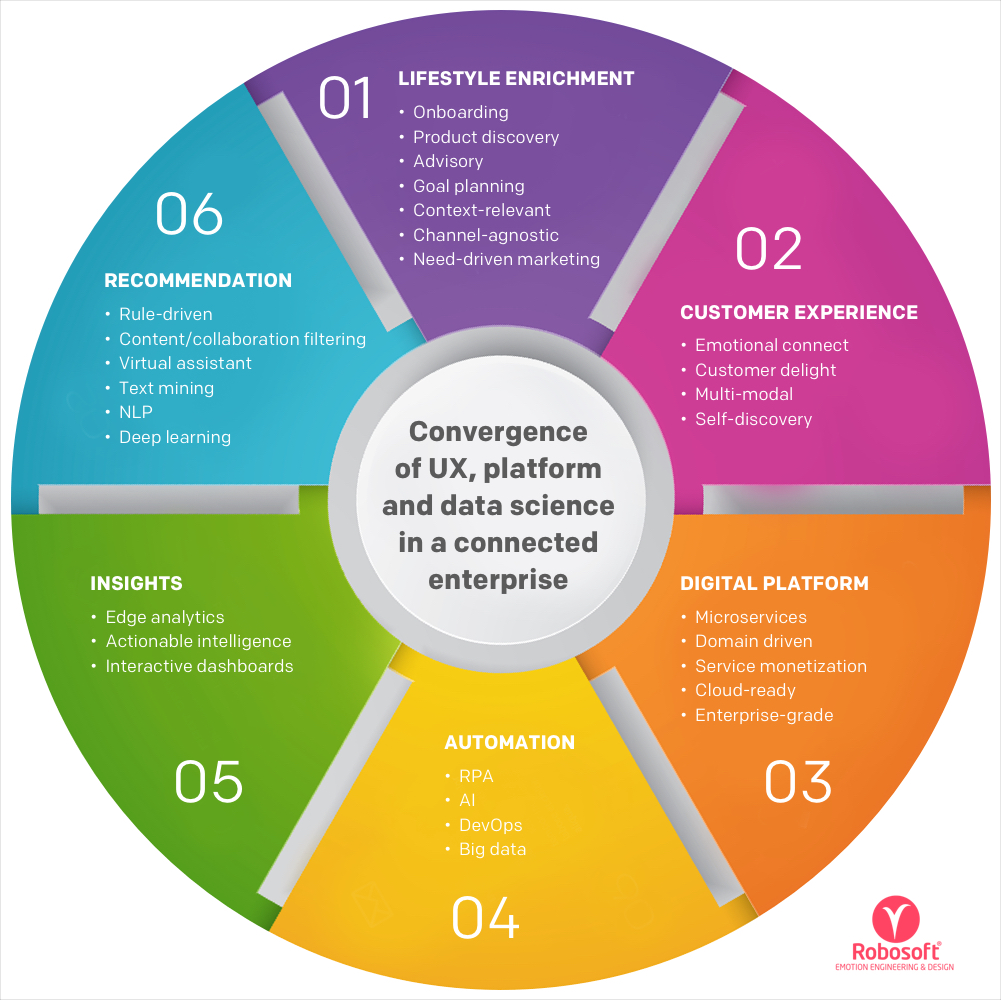
Increasingly, customers tend to base their perceptions of credibility, trust, and overall value of a brand through its digital experiences. In financial services, self-service dashboards, humanized banking, investment advisory, frictionless lending are common features which are digitally enabled. Personalized infotainment with natural language support and curated recommendations are seen in entertainment services. Similarly, across domains, enterprises can acquire segmented customers and offer a wide range of services by leveraging 5 levers of digital innovation:
Lifestyle Enrichment: With a combination of data and digital experiences, enterprises are in a position to know more about consumer needs and fulfill them at every stage in life. For example, in financial services brands can offer seamless client onboarding, personalized recommendations based on goals, advisory via a panel of experts, aggregate spend analysis, and provide tips on savings.
Recommendations to improve lifestyle such as goal planning, tracking performance of investments, providing a consolidated view of assets and liabilities, need-based promotional marketing, just-in-time recommendation, and so on are already in vogue.
Similarly, enterprises in other domains such as media & entertainment and e-commerce can use analytics and digital design to enrich their customers’ lives. The customer and relevant data should move across channels (app, web, wearables, bots, social, kiosk, branch, call center, advisor, distributor) seamlessly and securely. Such services will have to be made available on the most-preferred channel or location. While it can be challenging enterprises must remember that modern applications demonstrate many advanced characteristics that are driven by the user journey and help in addressing user needs.
Customer Experience: Many would know Design Thinking in abstract terms but very few have applied it in practice tied to customer’s “digital body language”. Many of the apps in the market may be superficially attractive – colorful in design, but weak on purpose, interaction style, or blending cutting-edge innovations. Firstly, there must be an emotional connect with users. Next curiosity must be evoked to learn more about the services and the ease of discovery or use. Once the app crosses the chasm, customer delight and adoption happen. Design Thinking principles can help businesses understand consumers better, empathize with them, and uncover valuable insights about their stated and latent needs & pain points. But beyond just principles, Design Thinking is action – helping enterprises understand their user’s pain points, conducting faster experiments, and finally building a product that drives business results.
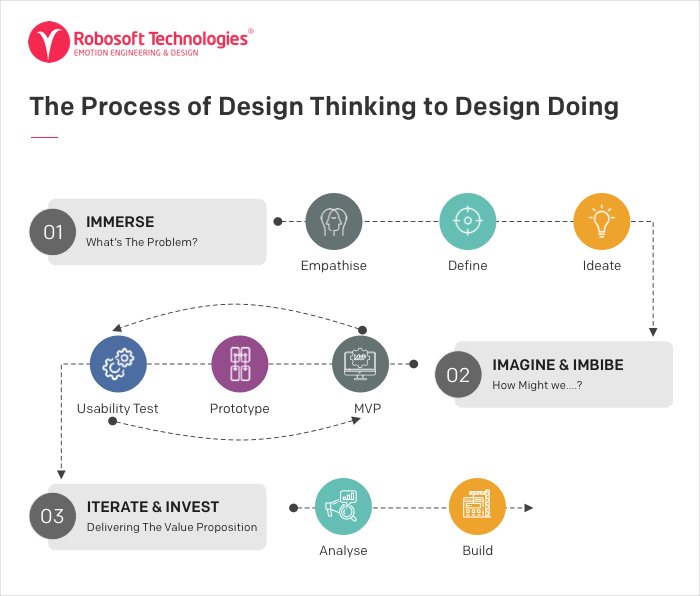
Designers and data scientists must converge to deliver a multi-modal, intelligent, and self-learning application to millennial customers. Technologies such as facial recognition, voice, video calling can be used to address customer pain points and enhance the overall experience.

Enterprise Grade Platform: Companies shall decouple Digital from Core via Open API and monetize services usage via open-source technologies. Each business application must be architected as a collection of cloud-ready enterprise-level micro-services inter-connected to digital use-cases that can be discovered, reused, and deployed across the company. Examples include customer onboarding, multi-factor authentication, personalized UI templates, work-flow engine, product catalogue, information overlay via AR, campaign manager, video & chat conversation, virtual assistant, recommender engine, predictive analyzer and blockchain storage.
Automation: Many companies have scratched the surface on operational processes and customer interaction automation. It has been automation of mundane back-end jobs and less of a hybrid approach of humans and robot’s judgment working in tandem. Successful digital transformation must focus on enterprise productivity, contextual interactions, and real-time recommendations.
Robotic Process Automation unifies enterprise-level data to bring context to customers, integrates regulatory compliance into standard operating procedures with exception reporting, delivers always-on services, and enrich human interactions. Convergence of RPA and AI will drive revenue and profitability and cross-sell to customer’s needs. Companies must bring automation to software deployment and rollout to markets via agile practices. Automation of marketing aided by AI, geo-location intelligence, and big-data user-item profiling is a necessity.
Insights: Insights about what motivates customers and their actions can be drawn from every conversation, transaction, relationship, grievance, and social sharing.
Analytics reside at the edge-node, and can provide insights on cross-sell, product holding, customer profitability and lifetime value, attrition and loyalty, customer sentiment, channel search & usage, transactions, service requests, leads, campaigns, churn, product profitability, risk, advisory quality and more.
The real value of dashboards lies in anticipating early and accurately what your customers want and acting on it.
Recommender system: driving retention and engagement
The role of a Recommender System is at the core in recommending items and driving customer conversion by auto-suggesting the right product to customers based on needs and behavioral data. A robust Recommender System will discover information for customers and “what to recommend” depends on the context i.e. movies, news, shopping, loans, insurance, funds, stocks, grocery, food, etc.
A Recommender System helps the company to increase revenues by providing the most likely items that a customer can purchase or increasing the engagement by showcasing the relevant product or content. It will encompass a context-based virtual assistant capable of mining data, text, audio, video, facial, and generate automatic responses from past experience and context by applying Deep Learning principles.
There are various models and methods to build an intelligent Recommender System:
Collaborative filtering systems are based on large sets of customers who bought similar products and uses ratings or performance to make a suitable recommendation. It works usually on customer-item interactions e.g. item bought, time spent. In case of the sparseness of ratings, auxiliary information such as item-content can be used via collaborative topic regression machine learning algorithms.
Content filtering systems look at customer profile and metadata on items and creates a watch list, and also recommend similar items to customers that this customer has liked in the past. A similarity scores calculated between any two items and recommends to the customer based on profile and interest. It starts with creating item profiles for each of the items. The customer profile is created using item profiles that the customer has liked and recommends items that this customer might like based on earlier preferences.
Unsupervised Learning has no label data and no prediction of any output. It finds interesting patterns and forms groups within the data. Clustering is typically used for customer segmentation and anomaly detection.
Natural Language Processing is an area where machines learn and understand the textual data to perform tasks. NLP collects text documents, divides the sentence into words, removes stopwords, converts the text into a numerical vector, and tracks unique words as vocabulary, counts the word, and normalizes the frequency of word occurrence.
Text Mining using machine learning involves building a text classification model and uses it for predictions on text data and to predict the sentiment of any given product review. Embedding technique can compare two distinct viewer journies on similarity and predict the probability of conversion by analyzing the average time spent on each of the unique pages. This is also used in supervised ML across use cases such as next possible action prediction, converted vs non-converted, product classification.
Deep Learning provides better feature extraction from item characteristics (text, image, video, audio). Deep Learning techniques such as convolutions and recurrent neural networks allow to model the structure and order in the data for performance improvements. Collaborative deep learning allows two-way interactions between rating matrix and content. With Deep Learning, the properties of the content (images, video, text) are incorporated into recommendations. Using Deep Learning, item-to-item relations are based on a much more comprehensive picture of the product and less reliant on manual tagging and interactional histories.
In summary, companies must think of customer and user scenarios first. Be a customer-focused data-driven company and measure critical moments of interaction to cross-sell and upsell with a Wow experience! You also need a reliable long-term partner who can provide advisory on digital, design a human experience, and engineer a scalable and intelligent solution to market.