Category : Media, News & Entertainment

Media, News & Entertainment

How video streaming evolved for industries beyond media & entertainment

With the onset of the COVID-19, OTT and video streaming saw a surge like never before. This rise was attributed to a number of factors: the amount of time people spent at home, fewer avenues of entertainment, reliance on digital media for day-to-day interactions like business meetings, doctor consultations, online classes, and more. Video platforms also became a necessary means to fill the gap of human connections in people’s lives. According to a survey done by Limelight, in July 2020 over 89% of respondents used video to communicate, and over 50% used it daily.

Last year, video conferencing became one of the most critical tools for all kinds of businesses including Edtech, Retail, Healthcare, BFSI, etc. A cloud communications service provider based in the US saw an increase of 843% in the video minutes consumed by its users across domains, out of which Telehealth usage grew the most. The financial services and education sector also saw a significant spike in usage.

In our earlier article, we explored how the new-age LMS platforms are leveraging video streaming and creating innovative solutions across all their offerings – employee onboarding, partner training, customer education, employee training, and more.

‘’As enterprises continue to adopt technologies for remote learning and collaboration for employees, technology companies are amending their features and support. In the years to come, effective use of Machine Learning and Artificial Intelligence, VR, adaptive learning approaches, gamification will increase in LMS.’’ Srinidhi Rao, Senior Vice President – Solutioning and Account Management, Robosoft Technologies

In another article, we outlined how the Retail industry is using video for customer acquisition, retention and engagement.


‘’Out of sight, out of mind,  is more pertinent than ever before.  Hence it is essential for retailers to use innovative approaches to remain on consumers’ radar. Videos play a crucial role in this as it’s a more visually engaging medium.’’ Jay Shah, Vice President, Pre-sales & Solutioning, Robosoft Technologies

OTT and video streaming have become a force to be reckoned with in an age when all the rules of engaging and communicating with customers have changed. In this article, we will outline how video streaming is being used in 5 key industries: Healthcare, FinTech, B2B SaaS, Real Estate, and Manufacturing.

Healthcare: Medical streaming becomes a powerful channel for medical professionals

Medical streaming in healthcare is a phrase that has a broad range of use cases. Starting from providing consultations to patients in remote places to supervising surgeries, live medical video streaming has seeped into every crevice of medical aid to simplify doctor-patient relationships. In response to the COVID-19, the Spanish health authorities implemented Telehealth services at the primary care level. In addition, some private health providers offered video consultations for the general public free of charge. For Vonage, a cloud communications service provider, overall video minutes used by its healthcare clients spiked by 727 percent from February to March last year. The major use cases where video conferencing was used were: telehealth apps providing remote consultations, therapy sessions, online staff training etc.

Even prior to the pandemic, usage of video in healthcare was already picking pace for video consultations, training, and more. Below are some key use cases of how the healthcare sector leverages video streaming:

Telemedicine: Telemedicine is a stream coined to make medical assistance reachable to a vaster population. Medical live streaming, though primarily used to provide consultations, has also been used to share knowledge, research, and equipment demos.

Remote Medical Scribes: Documenting medical records to keep track of patient history and other key details is important but also time-consuming if done by physicians manually. Thus, the medical community created scribes – a virtual medium where doctors outsource these clerical jobs to people offshore. Live streaming these details has cut down a great deal of time and increased work efficiency in hospitals. Apps like SmartMD helps physicians record their visits. While the app scribes notes directly into the patient’s chart, saving everyone time and getting the most out of your EHR.
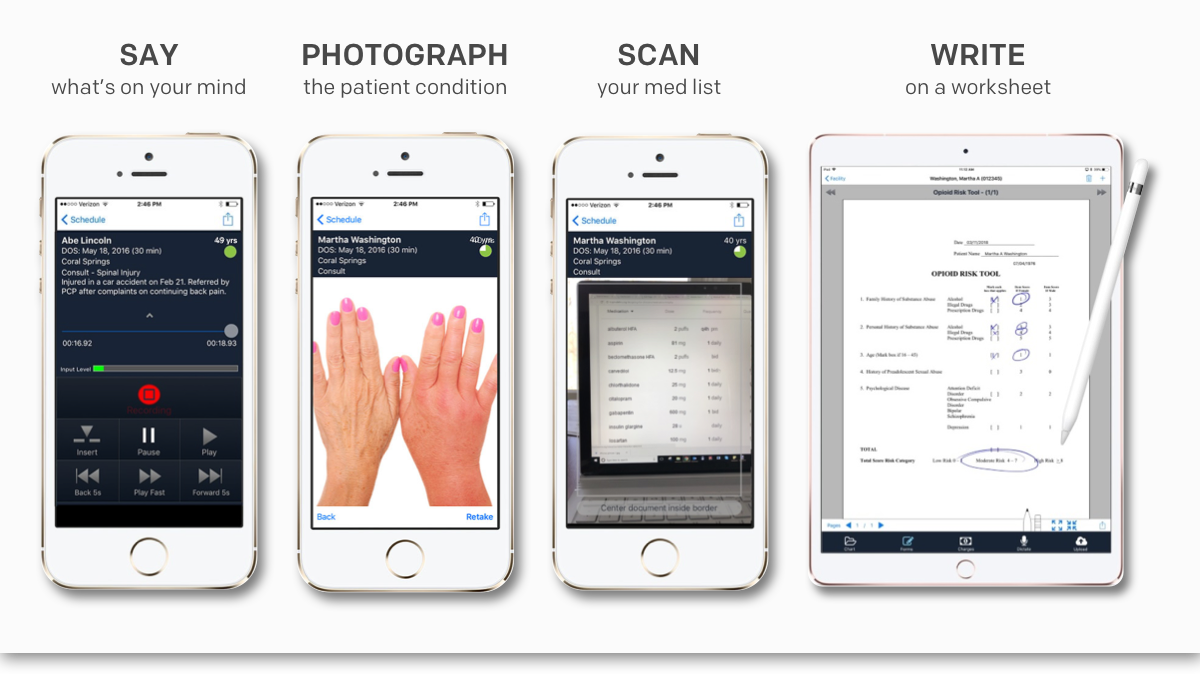
Image source

Virtual Training: Medicine is an ever-evolving field that needs its professionals to keep up with the catching technologies and other advances. Even practicing doctors are often in need of requiring brief training. Live streaming can help the medical community updated through e-learning options.

Surgeries: Surgeries that do not consist of a senior doctor in the place have been monitored through live video streaming and hold an interactive session to eliminate surgical risks. In some cases, surgeries have also been broadcasted to a larger audience as lessons to educate those who are in training.

Online Consultation: Live streaming consultations have given the patients a wider choice of good doctors, not only for treatments but also for attaining opinions on diagnosed problems. These online live streaming consultations in healthcare can be used to review prescribed medicines, treatments, and other medical records such as scans and X-rays. This feature has vastly enhanced the experience of medical assistance and has also cut down on patient wait time as they do not go to meet doctors in real-time.

Last year owing to the pandemic, many hospitals and health systems launched and expanded telehealth programs in a matter of days. In response to the quick demand in access, HHS healthcare began leveraging platforms such as FaceTime and Zoom for virtual visits covering a wide range of conditions, from urgent care, primary care check-ups, medication follow up and COVID-19 screenings. Owing to the increased usage of video streaming services healthcare providers like Aetna Healthcare, UnitedHealthcare, Humana also starting including telehealth in their reimbursements.

Fintech and BFSI: Video-based content to acquire, engage and retain customers

BFSI and FinTech sectors can leverage the power of video streaming to not just engage with customers but also help them use their products and services with ease. According to a report from Accenture, 48% of US millennials would like their banks to offer video banking.

Here’s how the video streaming is being leveraged in this sector:

Video Banking: As physical branches become less relevant banks are upgrading their digital channels and introducing innovative methods to communicate and connect with their customers. Video Banking is one such innovation, which helps bridge the human-interface gap. For instance, LiveBank offers Virtual Branch Banking for the banking sector. It is an omnichannel communication and collaboration hub for banks that aggregate all communication channels like text chat, video, and audio. LiveBank provides retail banks secure and friendly contact channels for its clients.

Reducing the processing time: the BFSI sector is using video streaming to simplify the paper-based processing of loans, accounts, etc. Ping An, a wealth management company based in China reduced the loan application time to 6 minutes with the face recognition feature of Live Bank. At Robosoft, we partnered with a leading insurance company for the integration of Robosoft’s Video Chat solution to support online claim surveys for motor insurance. The integration of Video Chat solutions helped to personalize the digital interactions between the claim managers and customers and eased the claims process.

Making BFSI more inclusive: SignVideo, a British Sign Language (BSL) video interpreting service, was used by Lloyds to make their customer service more inclusive by making video an integral element of their customer services operations. Similarly, Santander UK and HSBC also use SignVideo to make their services more inclusive.

Better customer service: In a survey done by Accenture, more than half of survey respondents expressed an appetite for a true omnichannel banking experience that would allow them to switch seamlessly between physical and digital channels. In a post-COVID world where physical interactions are limited, channel innovations such as video conferencing, virtual reality, and chatbots can bridge the gap of face-to-face interactions.

“Video banking shows customers that behind the bank, there is something. There are people that can actually help you. It’s not like talking to a machine, it’s like talking to a real person.” Grzegorz Młynarczyk, vice president of virtual banking services provider LiveBank

Video-based marketing: 85% of businesses use video as a marketing tool, and of those, 88% of marketers report getting a positive return on their investment. Furthermore, videos can be more engaging learning tools than other forms of content. Service and product offerings in the BFSI and FinTech sectors can be complicated. Videos enable businesses to distill complicated concepts into a short, digestible format and to tell a story that showcases even the most complex technology. Customers can visualize how a product or service can solve their challenges, even ones they may not have known they had.


An example of video simplifying a complex FinTech solution for its customers can be this video from Crypto Arbitrager, a Fintech enterprise that enables investors to make money on the difference in rates of cryptocurrencies: bitcoin and litecoin. The fintech solution video shows how Crypto Arbitrager allows you to profit from exchange rate differences.

[su_youtube url=”https://www.youtube.com/watch?v=wIkaPrPYNlk”]

B2B SaaS: Embracing the power of video across the sales funnel

B2B marketers have found that video content is more effective than written content. 59% of senior executives said they’d rather watch a video than read an article. Videos can play an important role throughout the sales funnel leading to conversions.

‘’Video marketing, especially for SaaS companies, involves utilizing video through the funnel to attract, convert and delight customers” Ed Laczynski, CEO of Zype

Video isn’t just for marketing anymore; it can play an influential role in the sales process now. The introduction of sales video platforms like Vidyard’s GoVideo and Wistia’s Soapbox has made it easy for sales reps to integrate video from their very first approach email.

These videos can be of various types – product demos, customer training videos, personalized videos embedded in email marketing campaigns, etc. Some examples to take a note of are:

Product explainer videos: Finalsite is a B2B SaaS company with more than 20 products and each one has a product video lasting under 60 seconds. PrecisionLender does a great job of addressing the key product questions in short 90 seconds videos.

Personalized sales videos: The Angle, a B2B tech marketing company used Wistia’s Soapbox to create a personalized video to promote a blog post. The video can be easily shared by the sales team in their emails to engage with the prospect.

Customer testimonials videos: Slack, produced this fun, two-minute video to tell the story of how the company’s platform improved Sandwich Video’s productivity. The video answers the main questions of any good testimonial video addressing the key concerns of decision-makers like quantifying the impact the product has made, product features, and more.

Real Estate: Video-streaming changing the rules of real estate purchase

The buying process in the real estate industry has evolved and Real Estate companies are using new-age technologies to engage with buyers throughout the buying cycle. At Robosoft, we partnered with one of the leading real estate development companies of UAE to create a mobile platform that can help buyers keep a track of their property-related transactions and create an engaging experience throughout the journey of home buying to living. We also worked with a service realty solutions organization that helps manage real-estate for private individuals, landlords and investors. We partnered with the client to create an aggregator web solution for landlords and tenants, for their property management requirements. From looking for a property to managing transactions and legal documents – digital has become a critical element.

Videos can help real estate enterprises engage with their customers better. Various ways in which the Real Estate sector leverage videos are: Virtual tours of the property, provide agent profiles to gain buyer’s trust, educational videos helping buyers learn more about the complex concepts surrounding the housing market like subprime mortgages, depreciation, and foreclosure, etc.

Tools like  BeLive.tv can help real estate enterprises to take interested buyers or agents on a virtual or remote tour of the house. Another type of video that the real estate sector can use is creating 360 views like Google Street through imaging equipment like Matterport 3D equipment, which is an enhanced imaging software. This camera does a high-res scan of every room in the house and creates a virtual, immersive, 3D experience.

Manufacturing: Customer education to process training videos are simplifying the manufacturing landscape

According to a Video Benchmarking report by Vidyard, High Tech, Professional Services & Media, and Entertainment & Publishing are the top three industries for video production. Manufacturing also ranks high on the list at number eight.

The manufacturing industry is leveraging videos as a powerful tool to show their customers, and investors, how the processes inside their factories work. For example, Rocket International, a national distributor of packaging supplies and equipment, put together a video that showcases the machinery that can be added to a line to place a carry handle to packaging. Similarly EVS Metal – a leading provider of end-to-end metal fabrication and manufacturing services gives a factory tour video that allows their buyers to see the size, conditions, capabilities, and products and services available at EVS Metal.

Another important use case of videos in the manufacturing industry is Process Training. Process training is an integral part of the manufacturing industry and videos are ideal to demonstrate step-by-step instructions that are useful for teaching the operation of a tool, product, or procedures. These how-to-videos pertaining to manufacturing are a better alternative to reading bulky manuals on the process because they provide visual stimulants that are easy to remember.

For the employer, these process videos reduce the time and resources spent on training employees how to carry out a process, while decreasing the learning curve for employees.

The manufacturing industry is also using immersive videos with AR/VR technologies for process tours, training, ensuring safety, and more. For instance, At the UK’s Eggborough Power Station K, tech companies Arithmetica and Transmission TX partnered to create an immersive VR training experience for workers at the power station, which delivers coal-fired power and biomass conversion. The VR experience simulated a real-life hazardous environment, providing a 360-degree video experience via consumer-friendly and fully available Samsung Gear VR headsets.

Ford, which outfits its employees with VR experiences to simulate the construction of upcoming models in its plants, years before the cars start rolling out of the warehouse doors. The intent of this VR application is to encourage workers to create the tools and processes they need in order to create a safer production environment. The introduction of VR in the manufacturing process resulted in an injury reduction rate of 70 percent.

In conclusion:

OTT and video streaming market is growing, while the COVID-19 pandemic accelerated this pace, the adoption was already underway. Industries beyond media & entertainment are leveraging video streaming for higher engagement with their customers. Be it educating the customers, communicating with them, or engaging with them – videos have become a critical aspect of strengthening the customer experiences. Additionally, videos are also helping in employee training, communication within enterprises, and more.

At Robosoft, we have the width and depth of experience crafting OTT and video app solutions. Our solutions are anchored on multiexperiencean approach focused on customer journey – providing multi-sensory, multimodal, and seamless experiences. We have partnered with several brands in crafting OTT solutions that have captivated users and delivered business growth through a combination of cutting-edge product strategy, UI/UX, and engineering services.

Know more about our OTT and video app solutions here.

Read More
Media, News & Entertainment

OTT video in retail – the coming revolution

Covid-19 pandemic has caused rapid changes in consumer behavior across categories. Enterprises are striving to recognize this evolving consumer behavior and leverage digital to acquire, engage and retain customers.

In the last few months, US retail sales fell by 8.1% year-on-year – the worst decline since the financial crisis of 2009. In the UK, retail footfalls dipped by 32%, and India saw a 40% drop in consumer spending. Sectors that relied heavily on their physical presence – brick-and-mortar retail have been among the worst-hit sectors during this time.

On the positive side, online businesses have seen a surge in revenues. In the times ahead, the acceleration of e-commerce and the role of digital experiences through apps will be a defining factor in helping retailers connect with consumers to acquire a competitive edge. The outbreak of COVID-19 has accelerated the pace of digitalization. A CNBC report mentions that 40% of consumers say they have increased or significantly increased their online purchasing.

A key component of the online purchasing has been the video platform.  Static images are giving way to streaming videos to better convey product and brand value.

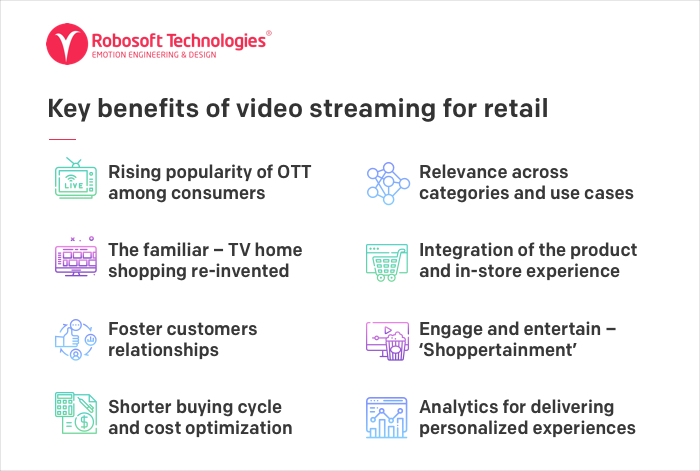
Key benefits of video streaming for retail 

Out of sight, out of mind is more pertinent than ever before.  Hence it is essential for retailers to use innovative approaches to remain on consumers’ radar. Videos play a crucial role in this as it’s a more visually engaging medium. Let us look at some of the factors triggering the need for video streaming in retail:

Consumer demand drives the popularity of OTT

The lockdown of more than ¼ of the world’s population has propelled the usage of online streaming and entertainment services. In the US, OTT usage surged by 7.5% in April 2020 compared to the same month a year ago. And during the last year, the number of streaming services subscribers surpassed the number of cable subscribers and reached a number of 613 million. Disney+ has had a 75% rise in subscribers since early February. The Discovery+ app that Robosoft helped build has garnered close to 4.5 million installs. This rapid adoption unveils a need for a more human connect which a video meets better than static images or text.

Increasing penetration of smartphones, affordable high-speed data networks, demand for personalized experiences, rise in adoption of smart TVs, and devices such as Fire TV are some of the reasons behind the rise in demand for Video OTT services.

Relevance across categories and use cases

Video OTT is no longer a vertical medium confined to the media and entertainment domain. It is now a horizontal technology that can be integrated into various industries like – education, healthcare, and retail, amongst others. Fortune Business Insight cites Medical Aid and Educational platforms as significant contributors to growth in the streaming video market propelling it to USD 842.93 billion by 2027.

A new format of the familiar – TV home shopping re-invented

The TV channels, as we know it, had a slew of video channels showcasing products.  However, the call to action to close the purchase loop was left to consumers calling up a number as there was no easy way to complete the purchase on the TV channel. The OTT technology in retail enables the best of both the worlds: the engagement of TV and the interactivity to explore options, make desired selections at own convenience and importantly place order and make the payment. Recently, the world’s largest air conditioner maker, Gree, sold 44 million USD worth of merchandise on Kuaishou, China’s leading short-video and live-streaming social platform.

Bring alive both the product and in-store experience (Video OTT for Brand promotion and Advertisement)

We have all experienced the gorgeous presentations of products in categories such as food, consumer goods, luxury, etc on the TV channels, evoking an emotion – a desire. Such experience is partially carried forward on social media platforms such as Instagram. According to Forrester, Instagram ads have the highest engagement rate of all digital ad placements. Several categories where visual appeal (food, apparel, interior decor) matters have taken advantage of the format. Video OTT adds a dimension of interactiveness and convenience to this.

Combined with AR/VR, it gives organizations the tool to bring the in-store experience to the digital channel rather than being merely a catalog of static images. In India, jewelry brand Tanishq has clocked a sales of USD 10.3mn in two months during the recent lockdown period through video calls and Whatsapp chats. Now imagine the brands in the retail domain across categories generating similar uptick in revenue using the OTT channel.

Taking a cue from this trend, in July this year, Google launched Shoploop, a video shopping platform for discovering, evaluating, and buying products, all in one place. Similarly, there have been more online video-based shopping apps that have been launched recently – for e.g. YEAY is the first app where products are sold solely through video. Bulbul is another – online Video Shopping app that is from India.  Enhancing the online shopping experience further, Dutch Cheese Merchant Kaan lets online customers order artisanal cheese and interact with staff in real-time as if they were actually inside the shop. A setup like Kaan’s Stream Store could fill the missing human element into the often impersonal experience of shopping online.

Foster customers relationships and build loyalty

This is also the time for brands to build a stronger connection with their consumers by personalizing and humanizing their experiences. Videos can help bring the human-connect in the consumer’s shopping experience that is beyond ‘click and buy’.

According to a recent report from Mckinsey, the specialty-apparel and department-store retail channels have already reached peak promotional frequency online, so it will be difficult for brands to break through with clear, differentiated offers that stand out from competition. As the holiday season nears, shoppers will be bombarded with messages about flash sales, BOGO deals and so on which will be lost among a sea of similar emails and digital ads. Retailers will have to re-evaluate their strategies to stand out and Video streaming used effectively can help do that.

Don’t just communicate – engage and entertain – ‘Shoppertainment’

A PWC report suggests that consumers are 50 percent more willing to try new brands at this time. And consumers are spending more time on social media and online streaming platforms. This is a great opportunity for brands to recognize this changing consumer behavior to further their leadership position using Video OTT. Strategies include connect with consumers with effective storytelling strategies using live streaming, influencer marketing, AR/VR, 3600 videos, and more.

Videos and live streaming will prove to be an effective tool to leverage the power of social media and get more buyers, for instance, Be.Live the video streaming format has seen a 70x increase in the number of customers using its live shopping feature. Similarly, Alibaba’s Taobao Live live streaming platform has surged.

The younger generation expects more engaging shopping experiences. Leveraging this trend large retailers are already leading the charge with interactive video. For example, Fandango’s streaming service Vudu has been investing in shoppable ads to uplevel their platform’s e-commerce capabilities. Alibaba has tapped into streaming platform Bilibili to leverage anime video content and get in front of new audience segments.

Further, according to Taobao (Alibaba), there were 400 million users watching its 60,000-plus Livestream shopping shows in 2019. The Livestream channels, hosted by brand stores or influencers, generated 200 billion yuan ($28 billion) last year. Shanghai Fashion Week in late March was fully live-streamed on it: viewers could pre-order the clothes the models were wearing on the catwalk, as well as buy pieces from the designers’ existing collections.

Shorten the buying cycle, optimize costs and expand revenue streams

Video medium could help in shortening the buying cycles by making pertinent features of the product more evident and reduce the number of returns resulting from mistaken selection. Video OTT can also greatly facilitate product exchanges by providing a near live in-store experience. Recently, Galeries Lafayette in France used live video to help launch an exclusive Live Shopping service, where interaction with the store’s personal shoppers are made possible via video. Products can be chosen and confirmed by email with online payment, ready for either home delivery or Click & Collect.

Smaller retailers are also jumping the bandwagon using video platforms to reconnect with their customers. The number of merchants using it for the first time grew by 719% from January to February. Sarah Akram a master aesthetician and founder of Sarah Akram Skincare, which caters to celebrities like Billy Porter and Zooey Deschanel moved to video format to offer virtual consultations and live skincare assessment through Instagram’s live feature.

The video medium has also opened several opportunities for B2C services as well. Shapermint a direct-to-consumer shapewear company recently began streaming live yoga practices, meditations, and home exercises as well as sessions on how to care for children while working from home.

Better analytics for delivering personalized experiences

Video-streaming platforms coupled with a digital backbone can remember customer interaction history and personalize their subsequent experiences. can offer detailed data reviews and analysis are available for a better brand and product sentiment and roadmap. Further, the data from these platforms can help in collecting qualified high purchase intention leads, allowing precise retargeting and remarketing. Roku launched a new shopper data program that is designed to improve targeting and measurement of TV advertising for CPG marketers, with Kroger Precision Marketing (KPM) joining as a launch partner. The information will help CPG marketers better target ads that run on Roku’s platform and tie ad exposure to online and in-store sales.

In conclusion:

While going back to normal may happen eventually, some shifts in consumer buying behavior may be permanent. Retailers are already shifting strategies and adapting to today’s current landscape. The pandemic turned more consumers into online shoppers across all categories. Retailers already believe that this could be the new normal. Given that, the audio-visual nature of streaming services will have a powerful impact on consumers as videos are the most engaging of visual media. Videos when done well and in a non-intrusive way can influence shoppers in their buying journey and help accelerate the purchase decision favorably.

Video platforms and live streaming will have a crucial role to play in the future because they offer a sense of community as well as entertainment — two things consumers are yearning for and two critical aspects of shopping. People buy things not just because they need them, but also because of the experience. Videos and live streaming have the potential to simulate a real-life experience, leading to a stronger brand association and hopefully a long-term relationship with consumers.

Read More
Media, News & Entertainment

OTT brands in the post-COVID world: 6 trends and opportunities in 2021

The rise in consumption of video and audio streaming services over the past year due to extended lockdown periods arising out of the COVID-19 pandemic has been covered extensively in media. The OTT viewership and streaming hours in the US and across the world shot up expectantly during the pandemic. All the major OTT trend reports suggest it will only grow further in the coming years after the pandemic. In hindsight, it was a natural fallout of having to stay indoors for long periods.  People resorted to options in indoor entertainment through streaming services and mobile games. 

OTT Services on Smart TV

There is a rapid exponential increase in OTT platform usage across the past decade. The OTT industry revenue is expected to ride the COVID-19 wave and reach over 210 billion dollars by the end of 2026. According to a recent CII-BCG report, the number of paid OTT subscriptions was up by 55-60% to 100-125 million in 2020 from 49 million subscriptions in 2018.

Another important factor for OTT ascendency is the introduction of 5G technology. The 5G technology is going to be a major factor assisting the increased usage of OTT services. Having 5G combined with OTT services would mean less buffering and faster streaming. This would encourage OTT service providers to venture into live sports and other events streaming.

What are the current OTT viewing trends?

The USA and Global

According to the 2020 report from Comscore, in the US, 69.8M homes used OTT in April 2020, an increase of 5.2M homes compared to the previous year. The same report also indicates the average home viewed 102 hours of OTT content during that same month, an increase of 17 hours compared to April 2019. Another report by theTradeDesk indicates 27% of the US households are going to end their TV subscriptions by the end of 2021. The trend was similar across the globe, for both video and audio streaming. In the US and UK, consumers shifted from audio to video streaming as the former was more suited to a commute while the latter for in-home consumption.

India

The BARC-Nielsen report from April indicates that in India, VOD viewership on digital was at 3 hours 59 minutes a day in week three of lockdown, with a 12 per cent increase from pre-COVID time. In March, audio streaming too saw a spike in India – there was a 42% increase in time spent on listening to them. 

OTT trends and opportunities for current and new brands

Now consider this – once the pandemic situation eases, more people will step out for their regular work, are things going to be the same hereon for OTT brands? 

Robosoft Technologies brings you 6 trends and opportunities for both established and new players in the OTT segment. These will discuss the impact of the trends and the way forward for OTT brands.

1. Need for a sharp brand value proposition

The OTT market is already cluttered in many geographies. A study from a major OTT market tracking organization, Parks Associates, suggests the number of OTT video services in the USA has more than doubled in the past six years to 300 platforms through the third quarter (ended Sept. 30, 2020). Similarly, India had 36 OTT streaming services and the number has gone up to 60 by mid-2020. New entrants are eyeing the market and the competition is only going to increase. The most important trend observed among Indian consumers is their willingness to pay for content during the pandemic. 

In this context, brands need to offer a sharp, differentiated value proposition primarily led by either a demographic or psychographic segment. A diverse country like India offers opportunities to target consumers by language preference. 

As seen through another key trend of 2020, there has been a continuous emergence of hyperlocal OTT services such as Hoichoi (Bengali), Aha (Telugu), Koode & Manorama Max (Malayalam), Planet Marathi OTT (Marathi), CityShor.TV (Gujarati), and more. 

In total there are 17 major languages for delivering OTT content in India currently. Each of these has its own vast library of content and niche audience. Segmentation through a lifestyle preference is also possible as seen with the successful launch of Discovery+ in India which has a unique proposition of unscripted content aimed at lifelong learners.

This hyper localization or segmentation through a niche can also be seen with the emergence of BritBox. It is an online digital video subscription service showing primarily British shows made available for UK, USA, Canada, and Australian audiences with South Africa next on the list.

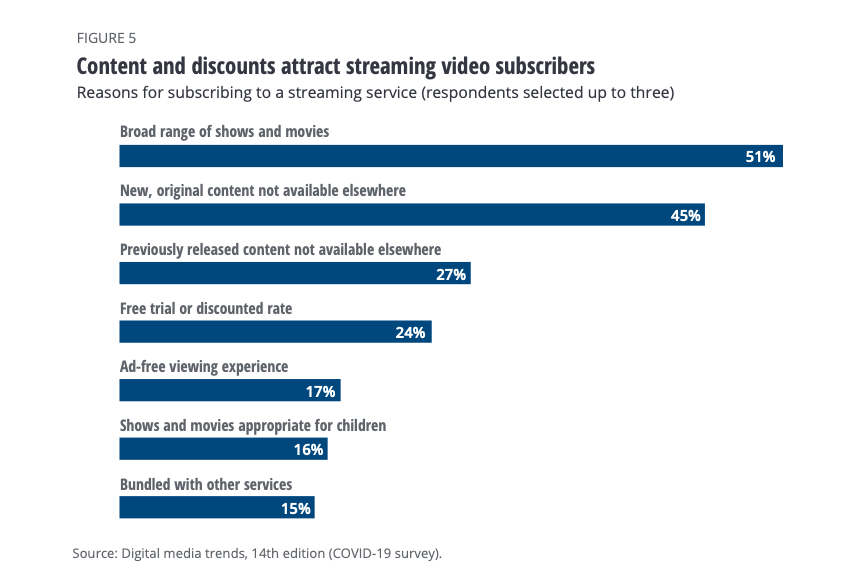
According to a survey conducted by Deloitte, in May 2020 among US consumers, the reason for choosing a particular brand of service seemed to indicate a preference for both a broad range of shows & movies and content not available elsewhere.

Content and discounts attract streaming video subscribers

Image source

It reflects in the content strategy of several brands which are now emphasizing ‘originals’ which then call for huge investments in creative talent and production costs. As consumers, we have also chosen to snack on a streaming service based on a particular show or movie and not renew the subscription when the show completes a season. To that extent, brand loyalty cannot be taken for granted in this segment. 

The above survey also found that 66% of people were frustrated when the content they wanted to watch was removed from service, and 53% were frustrated by having to subscribe to multiple services to access the content they want. From October 2020 to February 2021, the churn rate for streaming video services held at around 37%. 

Late entrants in a particular category will then have their work cut out to wean away from the audience from established players. There are several key factors to take into account while designing a successful OTT platform. A quick study and research go a long way in the successful journey of your idea.

Create a successful multi-device and multi-platform OTT App

2. No room for complacency in the post-COVID-19 era

Traditional cable TV is still the most popular option for entertainment for households in developing markets like India. Apps and digital experiences through personal computers and smart TVs have increased in popularity due to unexpected extraordinary circumstances. When the situation eases in the months to come, two factors will come into play – app fatigue and subscription fatigue. The former existed even before COVID-19.

The Deloitte survey mentioned earlier also indicates that even before COVID-19, the average US consumer had 12 paid media and entertainment subscriptions – with millennials averaging the highest at 17. The report goes on to say ‘with more subscriptions being added or sampled during the lockdown phase indications are that consumers have signed up for more services than they can handle or afford’. 

In my view, multi-experience indicates that streaming services have a twin task of answering ‘why to choose me?’ and also work at retention strategies. The price-value equation will be worked out by consumers driven primarily by the quality of the content and the ‘worth’ of such in dollar value. 

Due to the availability in abundance, a user may have 30-40 apps installed. But the ones which get used daily are perhaps only 4-5. However, here it’s a question of payouts every month and there’s a limit to the number of subscriptions and the monthly payout.

3. Room for growth, new audience, new devices

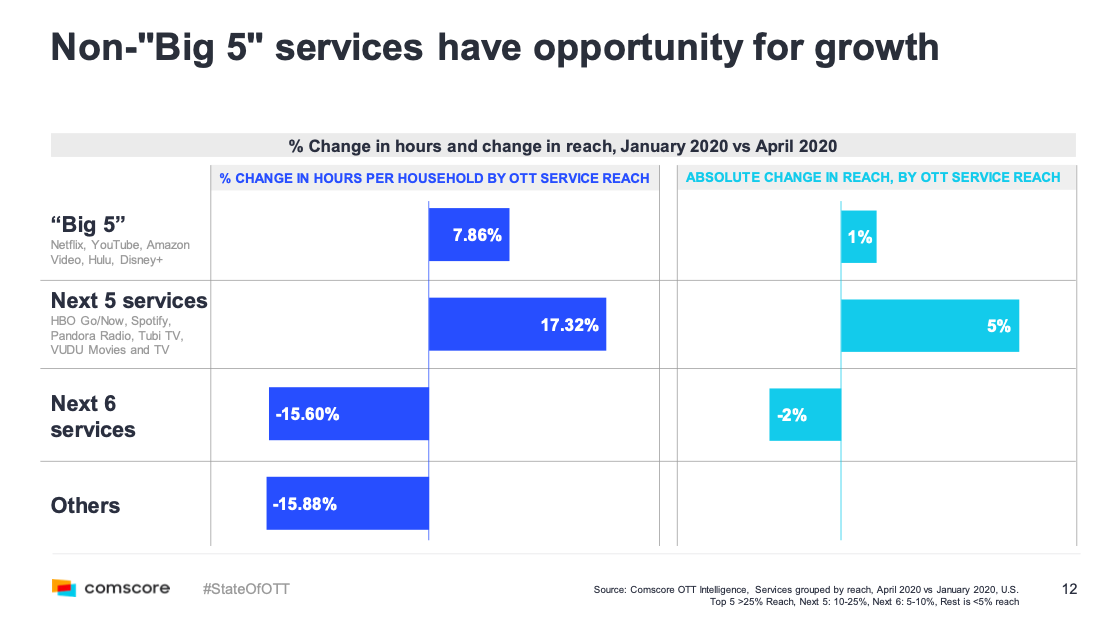
The OTT market already has big global players with deep pockets. YouTube, Netflix, Amazon Prime, Hulu and Disney+ are considered the Big Five in a Comscore report and they accounted for 82.5% of the streaming hours in April 2020. Yet, the next 5 services have a higher percentage change in hours per household in April as compared to January.

Change in hours and reach of Big 5 and non Big 5 OTT services

Image source

By the end of 2020, Apple TV+ has also garnered an audience with a captive base of iOS, Mac and Apple TV users. Indications are that there is still room for growth in terms of audience and devices.

The trend is expected to grow with Indian Originals having quality content expected to grow beyond the South Asian audiences in the coming days.

4. Table stakes: Success factors and expected features

Content creation, processing, storage & retrieval, content distribution and management continue to be the backbone of the OTT business. 

Over the past few years, growth and engagement have been dependent on customer experience, customer acquisition & retention, use of recommendation engines, technologies such as voice and presence in large screens such as Smart TVs.  

The high penetration of Smart TVs and the presence of big global players in the OTT market has also contributed significantly to the growth. Some content owners like Discovery Plus are going directly to consumers via Roku and OTT only operators like Amazon Fire TV for their content distribution. OTT players such as Netflix, Disney, NFL, and NBC have been investing in creating OTT TV apps to bring their videos directly to consumers with multi-experience options. Having a multi-experience OTT service enables the OTT platforms to provide multimodal, multisensory, and seamless experiences to their subscribers. 

See the work behind creating a multi-experience OTT platform for Discovery+

Discovery also made its first US pay-TV deal with Comcast for further distribution of its streaming services. The arrangement will enable the SVOD to be accessible on the Xfinity Flex OTT platform as well as traditional X1 set-top boxes. 

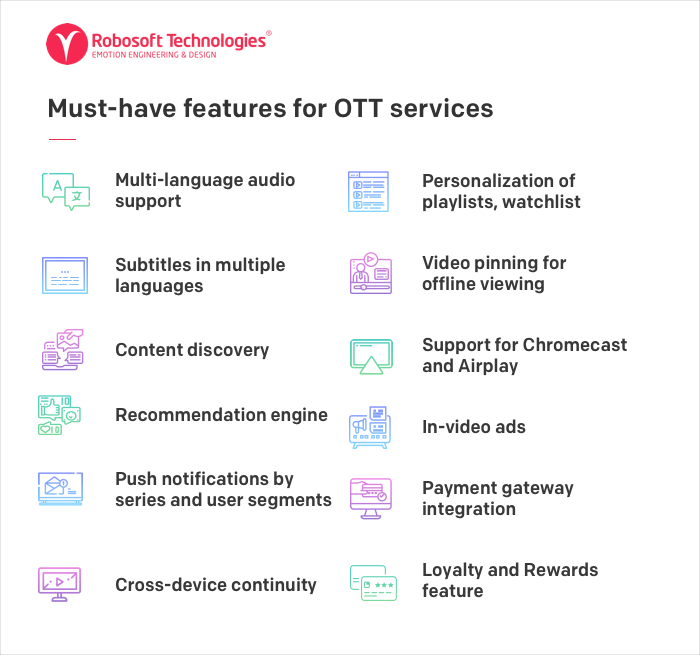
As parity features come into play (no pun intended) in OTT services, some key features will become table stakes for streaming services as shown below.

Key Features of OTT Services

5. Monetisation strategies: ad-support is welcomed

Streaming services are lowering the entry barrier by offering free trial periods and price-offs for a subscription. 

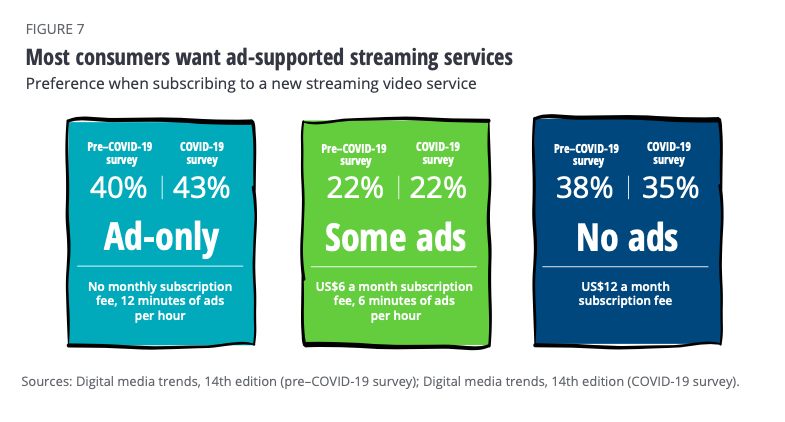
In markets like Asia, ad-supported services are common. As with publishing, a relatively smaller percentage of the market will be willing to pay a premium to avoid ads or have an ‘ad-lite’ experience and commit to a subscription. Deloitte’s COVID-19 survey found that 35% of consumers will pay a premium to avoid ads in the US. Providers are increasingly turning towards pay-per-view and advertising monetization as alternatives to subscription monetization.

In the months to come, streaming services may opt for a combination of snackable, short-term subscription options and advertising revenue to offset the high cost of production. The consumer, hitherto used to high-value, big-budget movie productions from Hollywood and other film industries, will expect similar production values from OTT content providers. Disney+ is already bundling its videos together with ESPN, National Geographic, and other content producers. This will likely expand in the future.

Survey finding consumers' preference for ad supported streaming services

Image source

6. More than just consumption with value addition

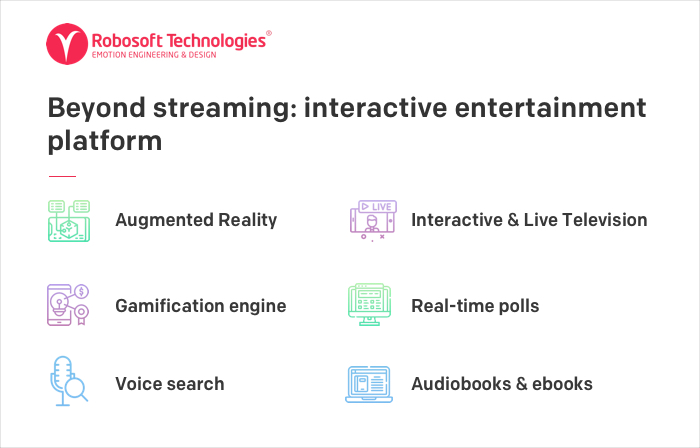
Brands in the OTT space can also position their services beyond passive consumption by enhancing their offering to include gamification engines, interactive live television, real-time polls and more.

Interactive Entertainment Platform

Connected TVs are becoming increasingly popular among US household. The consumers’ preference to watch the OTT content on a larger screen led to a significant jump in the usage of Smart TVs from 37% in 2018 to 51% in 2020. This jump however doesn’t affect the demand for mobile streaming on smartphones and tablets.

Another interesting space that is developing quietly is the diffusion of retail into OTT platforms. The traditional TV ads fail to deliver a direct purchase option for their consumers as they have to dial-up a number or visit their website for the sale to happen. However, OTT platforms have the potential to bring the best of both worlds. The interactivity, convenience of time, and most importantly the ability to make purchases on the platform itself. 

Netflix is again on the verge of major disruption in the OTT space with their online shopping store. This will provide fans of particular TV shows or cinemas with collectables from the show. This innovation is surely a major step for Netflix to keep their consumers on their platform and increase brand loyalty.

Conclusion

In summary, the situation which existed before the COVID-19 pandemic has been accelerated over the past few months. Consumers who used to sample a service due to free offers or a favourite piece of content have had a plethora of options to choose from. 

A churn is inevitable in the coming months as both the consideration set and the purchasing power of most consumers are limited. Yet, with a sharply differentiated positioning, investment in relevant content, smart acquisition & retention strategies and above all, crafting a great customer experience across devices the future augurs well for both established and new players in the domain.

Read More
1 2 3