
What gets measured and what should be measured
When live streaming issues occur during a major live event, the post-incident conversation follows a predictable pattern. Engineering teams review server logs. Capacity planning gets revisited. A root cause analysis is written and filed. The incident is closed.
What rarely gets measured with the same rigor is what happened to the audience during those minutes or hours of failure. How many opened a competitor platform and did not return, with session abandonment rates during live event failures reaching as high as 16.7%. How many cancelled their subscription in the following 48 hours, in an industry where annual churn already sits at 50% and a single poor experience accelerates that decision. How many posted about the failure publicly and shaped the perception of the platform for people who were not even watching, with app uninstalls surging over 30% after service failures and 79% of consumers expecting a public response within 24 hours.
The technical incident has a clear beginning and end. The commercial and reputational consequences do not. And the gap between how thoroughly platforms analyze engineering failure and how thoroughly they analyze the audience’s response to it is where the real cost of live event failure lives.
The commercial reality
Cancellation rates spike within 24 to 48 hours after live streaming issues or a significant platform failure during a high-profile event. When live streaming fails, the spike is not random. It is concentrated among the subscribers who were most emotionally invested in the event they were trying to watch. These are precisely the subscribers a platform most wants to retain. The ones who organized their evening around the content. The ones who recommended the platform to others because of it. The ones whose loyalty, once lost, is the hardest to rebuild.
Acquiring a new subscriber costs significantly more than retaining an existing one. And the loss goes beyond the cancelled subscription every subscriber who leaves takes with them their lifetime value, the full future revenue they would have generated had they stayed. For the most engaged subscribers, that is a figure that compounds with every month they are gone. A live event failure that drives even a modest percentage of highly engaged subscribers to cancel represents a commercial impact that dwarfs the cost of the engineering investment that would have prevented it. That calculation is worth doing before the next live event, not after it.
The reputational reality
The commercial impact is measurable. The reputational impact is harder to quantify but, in many ways, more significant.
Live events are shared experiences. A sporting final, a major awards show, a national broadcast event. The audience is not watching in isolation. They are watching with others, discussing in real time on social platforms, and sharing the experience across multiple channels simultaneously.
When a platform fails during one of these moments, the failure becomes part of the shared experience. It gets discussed, posted, and remembered. Not just by the people who were directly affected but by the much larger audience who saw their reaction.
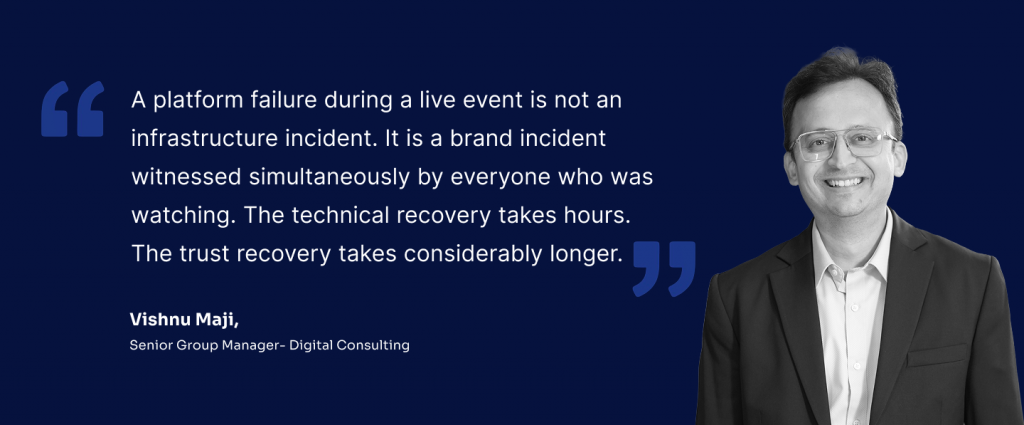
In our experience building and sustaining platforms through major live events, the reputational effect of a significant failure outlasts the technical incident by months. Audience trust, once broken at a moment of high emotional investment, does not recover on the same timeline as a server to restart.
Why most platforms underinvest until it is too late
The engineering investment required to build a platform that holds reliably at 500,000 or 1 million concurrent users is substantial. It requires architectural decisions made early in the platform to build. It requires load testing at a scale that most teams find difficult to justify before a failure has demonstrated the need for it. And it requires ongoing investment in monitoring, capacity planning, and infrastructure that does not produce visible output until the moment it is needed.
This creates a structural tendency to underinvest. Roadmap priorities with immediate, visible returns consistently crowd out resilience investment. Infrastructure costs are categorized as overhead rather than revenue protection. And worst-case scenarios, by definition, have no visibility until they occur. The cost of the investment is immediate and visible. The cost of not making it is deferred and invisible, right up until the moment it is not.
The platforms that get this right make a deliberate decision to treat live event engineering as a strategic investment rather than an operational cost. They build for the peak load, not the average load. They test the conditions they have never experienced yet, not just the ones they have. And they monitor continuously rather than reactively.
What the right investment looks like
Building a platform that performs reliably during live events at scale is not a single decision. It is a series of architectural and operational decisions that are compounded over time.
The foundation is a streaming architecture built on cloud-native principles designed for elastic scaling. A platform built on fixed infrastructure has a hard ceiling on concurrent users. A platform built for elastic scaling can expand capacity in response to demand rather than being limited by what was provisioned in advance.
Beyond architecture, the investment that most platforms underestimate is in testing. Load testing at realistic peak concurrency levels through global load simulation, under realistic network conditions, across the full range of devices and geographic locations the audience will use including failover testing across regions to verify that backup infrastructure holds under pressure. Not once before launch but continuously as the platform evolves and the audience grows, with chaos engineering exposing how systems behave under real failure conditions long before a live event does.
Underpinning all of it is monitoring. Not reactive monitoring that alerts a team when something has already failed. Proactive monitoring that identifies the conditions that precede failure early enough to act before the audience is affected.
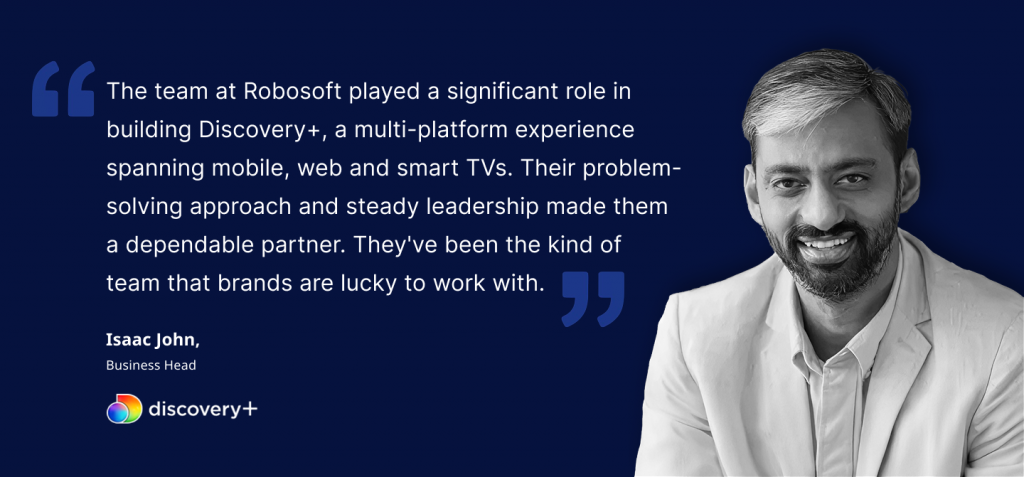
When Warner Bros. Discovery needed a platform capable of sustaining live Olympic and FIFA World Cup streaming, these were the foundations on which the entire platform was built. The result was a platform that held over 1 million concurrent users during some of the most watched live sporting events in the world.
The question every platform should be asking
Conversation about live event engineering usually happens after a failure. It should happen long before one.
Three questions worth asking honestly before the next live event:
What is the maximum concurrent load your platform has been tested to sustain, and how does that compare to the peak audience for your next major live event? What is your current time to detect and respond to performance degradation before it becomes a failure? And if your platform experienced a significant failure during your most important live event of the year, what would the commercial and reputational impact be?
The answers define the investment case more clearly than any engineering specification.
Robosoft Technologies builds OTT and streaming platforms for some of the world’s most demanding media organisations, from live Olympic and World Cup streaming at 1M+ concurrent users to multi-platform experiences trusted by global content brands. If you are thinking seriously about your platform’s live event capability, we would be glad to have that conversation.