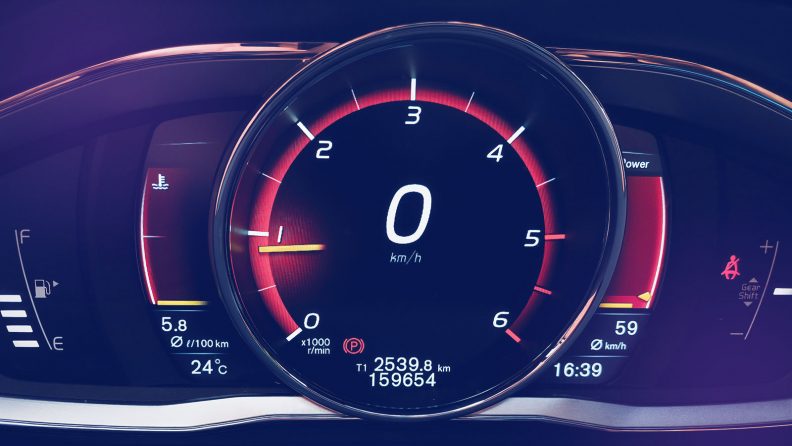
Every major automaker is making the same claim. The next competitive battleground is not under the hood. It is on the dashboard. AI-powered cockpits that learn driver behaviour, anticipate needs, and connect the vehicle to the rest of a driver’s digital life.
The engineering reality is more varied than the announcements suggest.
Having built some of the most technically demanding cockpit systems in production today, across motorcycles, supercars, electric trucks, and connected vehicles, we have a clear view of where cockpit AI is genuinely delivering value and where the gap between ambition and production reality remains wide. This is our honest assessment of both.
What an intelligent cockpit actually means
A genuinely intelligent cockpit system is not one that responds to voice commands or adjusts a seat profile. It is a system that processes real-time data from multiple inputs simultaneously: driver behaviour, road conditions, calendar context, and device ecosystem. It makes contextually appropriate decisions without requiring explicit input, refines its behaviour over time, and does all of this without adding cognitive load to the driver.
That is a very high bar. Most production systems today achieve some of these things some of the time. The gap between some and all is where the most consequential engineering problems live.
The conversation at CES 2026 moved decisively from software-defined vehicles to AI-defined vehicles, where competitive advantage is determined not by feature count but by the ability to deploy, validate, and continuously improve intelligent cockpit behaviour across a vehicle’s entire lifecycle.
Where cockpit AI is genuinely delivering
Driver monitoring and safety
This is the clearest win. AI-powered driver monitoring systems tracking eye movement, head position, and physiological signals have moved from concept to regulatory requirement. The EU’s General Safety Regulation now mandates driver drowsiness and attention warning systems in new vehicles, with advanced distraction recognition phasing in through 2026.
The architecture is well understood onboard inference models running on purpose-built SoCs, with edge processing ensuring low latency and data privacy. The challenge is not whether it works. It does. The challenge is how gracefully it integrates with the rest of the cockpit software stack without creating alert fatigue or conflicting with other safety-critical systems. Getting that integration right is as much a design problem as an engineering one.
Personalisation at the session level
Modern cockpit platforms have made meaningful progress in session-level personalisation: recognising the active driver, recalling preferences, and reducing time-to-ready for each journey. This is not transformative AI, but it is a genuinely useful experience engineering.
The underlying limitation is that most personalisation remains profile-based rather than predictive. The system recalls what a driver has done rather than anticipating what they need next. Closing that gap requires on-device ML models trained on longitudinal behavioural data, which raises serious questions around data governance, privacy architecture, and consent frameworks. These are product and legal engineering problems as much as ML problems, and they deserve the same rigour.
Natural language and agentic interfaces
Large language model integration into voice interfaces is the most significant architectural shift happening in automotive digital cockpit software right now. Systems capable of handling multi-turn, contextual natural language conversations are beginning to appear in production. At CES 2026, Bosch unveiled its AI extension platform built with Microsoft and NVIDIA, designed to retrofit existing cockpit automotive systems with advanced voice assistance and interior scene understanding.
The engineering challenge is running capable NLP inference within the thermal and power constraints of a vehicle head unit, with acceptable latency across variable real-world network conditions. The gap between demo performance and production reliability remains material. The trajectory, however, is clear.
Where the hype has run ahead of reality
Gesture control and interface novelty
Gesture control is the most visible example of a feature shipped before the UX case was made. It exists, it is technically impressive, and for most drivers, it is slower, less reliable, and more cognitively demanding than a physical control or a touchscreen tap.
The lesson is not that gesture control is categorically wrong. It may have genuine applications in specific contexts. But a feature should not ship until it is reliably better than what it replaces. Novelty is not a product requirement. In cockpit HMI, every interaction competes for the driver’s attention. A feature that impresses in a demo but adds uncertainty at speed has failed, regardless of how sophisticated the underlying technology is.
Fragmented connectivity
AI-powered dashboards routinely promise seamless integration with smart home platforms, cloud services, and vehicle-to-infrastructure networks. The reality in 2026 is more fragmented. Connectivity across OEM platforms, third-party apps, and backend services remains inconsistent because the underlying protocols, data models, and API contracts are not standardised.
Building genuinely connected cockpit software means investing in middleware that handles graceful degradation, conflict resolution between data sources, and resilient fallbacks. Unglamorous but essential engineering.
The AI everywhere trap
Adding AI to every cockpit interaction is not the same as building an intelligent cockpit system. When every function is surfaced through a single conversational layer, cognitive overhead increases rather than decreases. The best AI interactions in a vehicle are the ones the driver never consciously notices. Intelligence in cockpit design means knowing when not to ask the driver for input.
The software-defined vehicle changes the equation
The most important structural shift in the digital cockpit AI landscape is the transition to the software-defined vehicle. When cockpit behaviour is defined in software, deployable over the air, updatable post-sale, and testable in simulation before it reaches production hardware, the entire product development cycle changes.
This creates three foundational imperatives for engineering teams. Continuous delivery pipelines for vehicle software: OTA update infrastructure is no longer optional. The ability to ship, measure, and iterate on automotive digital cockpit features post-delivery is now a core organisational capability. Simulation-first development: hardware-in-the-loop and software-in-the-loop environments reduce the cost and cycle time of validating AI-driven features before they reach physical vehicles. And platform abstraction: the move toward AUTOSAR Adaptive, COVESA VSS, and standardised middleware layers is gradually making cockpit software more portable across hardware platforms.
What production-ready cockpit AI actually requires
The proof is in programs that shipped. The Volta Zero electric truck required information hierarchy, interaction design, and rendering performance to be solved together across a triple-screen cockpit designed for a central driving position in dense urban environments. A failure in anyone compromised all three. The Ford GT required a sub-five-second boot time that was never an engineering target design worked around, it was a shared constraint from the first day of the project. The Triumph motorcycle HMI, now on over 150,000 bikes, was built around a single governing question: what does a rider in motion, who cannot give the display their full attention, actually need?
Each of these programs required design and engineering working as one discipline, not in sequence. That integration is not a delivery preference. It is the only reliable way to build cockpit software that holds together when it matters.
The most impactful advances in cockpit AI over the next three to five years will come from context fusion rather than feature addition. Cockpits that combine behavioural history, V2X signals, and real-time road conditions to surface the right action without being asked. Systems that rely increasingly on on-device intelligence as edge AI silicon matures. And data architectures that treat transparent consent and on-device processing not as compliance obligations but as trust requirements foundational to adoption.
The question for any automotive engineering team right now is not whether to invest in cockpit AI. That decision has already been made. The question is whether the right people, process, and platform are in place to turn that investment into software that drivers trust.
Robosoft has been building toward that answer for thirty years. We would welcome the chance to work on it with you.
To discuss how Robosoft approaches automotive HMI and cockpit AI challenges, visit robosoftin.com or contact us at [email protected]