
It fails three months earlier, in the gap between design and engineering. The products that lose user trust rarely do so dramatically. There’s no single moment of collapse. Trust erodes in the small failures: the error state that gives no useful guidance, the critical alert that doesn’t register under pressure, the interaction that works perfectly in testing and falls apart in the field. By the time these failures surface, the decisions that caused them are months old, in the case of vehicle HMIs, often years old. And in most organisations, they were made in the space between design and engineering that everyone assumes someone else is managing.
Nobody is managing it. That gap is where interfaces go wrong.
Two kinds of failure
There is a version of product failure that is visible and recoverable. A confusing checkout flow. A navigation pattern that takes three taps instead of one. These are real problems, but they are findable problems. They surface in research, get prioritised in a backlog, and ship in the next release.
Then there is the version that is neither visible nor recoverable. It lives in the degraded states, the error conditions, the moments of peak load or highest consequence, and it was built long before launch. Not because anyone made a bad decision, but because the people making design decisions and the people making engineering decisions were never in the room at the same time.
This is the gap that most organisations treat as normal. Design works upstream, engineering works downstream, and the interface that reaches users is the product of that handoff, complete with all the compromises a handoff produces. In low-stakes environments, those compromises are survivable. In the sectors where Robosoft works: automotive, financial services, healthcare, and enterprise platforms, they are not.
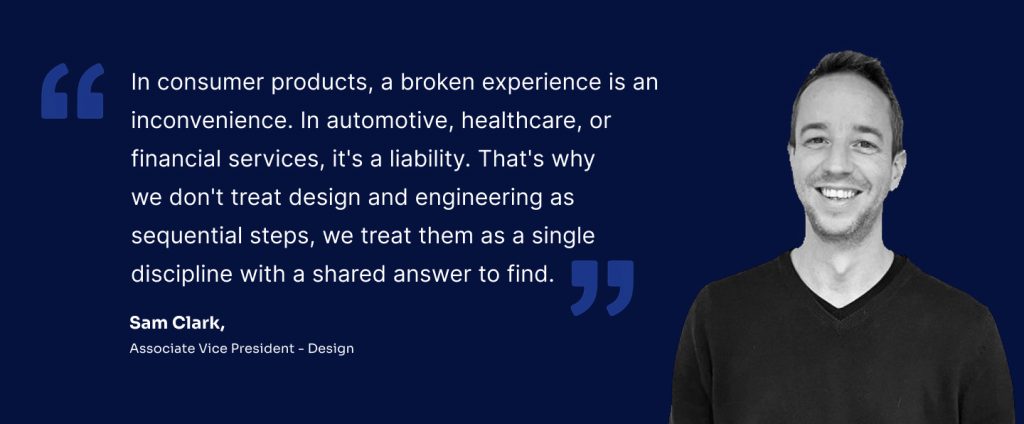
The question worth asking isn’t why interfaces fail under pressure. It’s why the industry keeps building them in a way that makes that failure almost inevitable.
The pressure test most products never pass
Consider what it means to design for a user under pressure. Not the user in a usability lab, completing a task in a quiet room with full attention. The professional is managing a critical dashboard while handling two other demands simultaneously. The driver processes navigation, speed, and road conditions at once. The financial platform user is attempting a transaction, but the network degrades.
These aren’t edge cases. They are the ordinary conditions under which real people use real products every day. And the interfaces built without them in mind will fail them, predictably, repeatedly, and in the moments that matter most.
The Triumph motorcycle HMI, a full-colour circular display that shipped on over 150,000 bikes and won the HMI Europe Award, is a good example of this in practice. The central design challenge wasn’t the interface in ideal conditions. It was the interface for a rider in motion, managing multiple information streams, who cannot and should not give the display their full attention. What needs to be visible always? What can be available on demand? How does the system transition between its two modes without creating a moment of uncertainty at exactly the wrong time?
These questions cannot be answered by design alone or by engineering alone. The answers depend on what the hardware can render in real time, what the processing constraints allow, and what latency is acceptable at speed. They require both disciplines to solve the same problem in the same room, and that only happens when integration is built into how the team works from the start, not patched in at the review stage.
The Ford GT tells the same story. A supercar where the HMI had to be worthy of the car, which meant a sub-five-second boot time wasn’t a target engineering worked toward after design had finished. It was a shared constraint that shaped every decision from the beginning. The Volta Zero electric truck is another case in point: a triple-screen cockpit for a central driving position in dense urban environments where information hierarchy, interaction design, and rendering performance had to be resolved together, because getting any one of them wrong independently would compromise all three.
In each case, the interface works because it was never treated as a design problem with an engineering solution. It was treated as one problem, owned by one integrated team.
What AI changes and what it doesn’t
The conversation in experience design right now is dominated by AI, and rightly so. Adaptive interfaces, personalised flows, generative UI: these are genuine advances in what products can do. They are also, if introduced without discipline, a significant way to make a complex product more overwhelming.
But AI doesn’t change the underlying challenge. It amplifies it. If the gap between design and engineering already produces interfaces that break under pressure, adding AI capability into that gap doesn’t close it. The result is a product that is technically more sophisticated and experientially less trustworthy, which is precisely the wrong trade.
The answer emerging from the strongest product teams is not simpler interfaces. The systems enterprises depend on are complex because the problems they solve are genuinely complex. Removing screens doesn’t remove that complexity. It transfers it to the user. The answer is interfaces that absorb complexity deliberately: that sequence information so the right thing is visible at the right moment, that distinguish between routine interactions and critical ones, and that adapt to context without making that adaptation feel arbitrary or opaque.
In 2026, the measure that has never changed is this: does the interface make the user feel capable? Not impressed. Not informed. Capable. Everything else follows from that, and it’s a standard that no amount of AI capability achieves on its own.
Building for the moment that matters
Thirty years of building digital products across more than 2,000 enterprise projects and 35 countries has taught Robosoft one thing more clearly than any other: the quality of a digital product is determined not by what any single discipline contributes, but by how early and how genuinely those disciplines work together.
The design decisions that are hardest to undo are the ones made without engineering input. The engineering decisions that cause the most user experience damage are the ones made without design input. This isn’t a process observation. It’s a structural one. Parallel working, shared ownership, integrated quality from day one: these are not efficiency preferences. They are the only reliable way to build something that holds together when the pressure is real.
This is what Robosoft’s model is built around. Not a design as a finishing layer applied to an engineered product, but experience, software, data, and AI working as a single discipline toward the same outcome: a digital system that earns the trust of the person using it, in the moment they need it most.
That is the standard high-stakes digital environments demand. And it is the one we bring to every engagement.
To explore how Robosoft approaches complex digital product challenges, visit robosoftin.com or contact us at [email protected]