
Most digital CX strategies are solving for a customer who is changing faster than the strategy can keep up. They are optimizing for the person tapping through screens, but the most forward-moving customers are increasingly delegating that experience entirely to AI agents that act on their behalf. When those agents hit friction in your experience, they do not complain. They do not churn in any way your analytics will catch. They simply never come back.
That is not a technology observation. It is a strategic problem that is quietly compounding in most organizations right now.
Physical and digital touchpoints are converging. AI agents are beginning to browse, compare, research, and transact on behalf of customers. And the gap between how well leadership thinks the experience is performing and how customers actually feel about it remains stubbornly wide.
Building a future-ready digital customer experience means designing for this new reality, not the one that existed three years ago. The organizations doing this well share five common traits.
-
They Stopped Mapping Journeys. They Started Owning Them
Forrester predicts that two-thirds of CX teams will abandon traditional journey mapping in 2026. The response in many boardrooms has been confusion: if journey mapping is failing, what replaces it? The answer is not a new methodology. It is a different ambition.
Traditional journey maps document how customers move through an experience. They are, by definition, backward-looking. What leading organizations are building instead are intelligent platforms where context, intent, and progress carry forward at every handoff, digital to digital, digital to physical, in real time. The journey does not get mapped. It gets owned.
CASE STUDY: Brightline
Brightline, the only privately-owned intercity railroad in the US, came to us with five disconnected systems: mobile booking, QR-based station entry, GIS-powered parking navigation, integrated ridesharing, and physical station infrastructure. This was a customer digital transformation challenge at its core. Passengers were being handed off to each other with no continuity. The insight driving our redesign was not that the systems needed better integration. It was the passenger’s intent, getting from A to B with as little friction as possible, that should persist across every touchpoint without them having to restate it. We rebuilt across native apps, responsive web, and kiosks with that principle as the foundation. One seamless experience emerged from five fragmented ones.
-
Personalization Based Only on History Is a Broken Promise
Most personalization engines tell a customer who they are. The best digital experiences tell customers you understand what they need right now. These are fundamentally different capabilities, and the gap between them is where trust is won or lost.
Historical data has real value. But it creates a ceiling. A customer who researched retirement funds last quarter may not be researching them today. A business user who typically accesses a dashboard from their desktop now needs it on a phone, in a meeting, in thirty seconds. Contextual awareness, understanding where someone is in their decision, what they are trying to accomplish, and what they are holding is what closes that gap.
CASE STUDY: Invesco
When Invesco needed to bring advisor-investor workflows into a single mobile-first experience, the design challenge was not building a better dashboard. It was building the right dashboard for each advisor’s specific work context, at the moment they needed it. Portfolio performance, fund recommendations, and business indicators had to surface differently depending on whether an advisor was in a client meeting, preparing for one, or reviewing end-of-day numbers. We designed around real work patterns, not historical usage data. The result was a tool advisors actually changed their behaviour to use which is the only meaningful measure of whether contextual design has worked.
-
Inconsistency Is Not a Design Problem. It Is a Trust Problem
When a customer encounters a different experience on your app, your web portal, or your customer service interface, they do not think: ‘Their design team lacks coordination.’ They think: ‘I do not fully trust this organization.’
This is why Forrester expects 80% of companies to invest in design systems in 2026, not as style guides, but as infrastructure with dedicated product budgets and ownership. A design system is the difference between CX that moves at sprint speed and CX that moves at customer speed. It also breaks the dependency between content teams and engineering, which creates bottlenecks whenever a customer-facing change is required.
CASE STUDY: BSI (British Standards Institution)
BSI operates across 193 countries, serves over 80,000 businesses, and runs five interconnected platforms spanning mobile audit tools to supply chain risk dashboards. Inconsistency at that scale does not just frustrate users it undermines the credibility of an organization whose entire value proposition is the reliability of standards. We began with design thinking workshops, then built a system of 100+ UI/UX components and a comprehensive style guide, now underpinning every platform. The design system became the product. Everything built on top of it became faster, more consistent, and more trusted by the users who depend on it.
-
One Metric Should Govern Everything
The most expensive mistake in digital CX is building something that looks sophisticated but does not move the number that matters. Leadership celebrates the launch. The metrics barely shift. The team cycles into the next initiative without understanding why.
Future-ready CX is designed backward from a North Star Metric: a single measurable outcome the experience exists to drive. Not a suite of engagement metrics. Not a balanced scorecard. One number. Every design decision, every feature prioritization, every technical trade-off is evaluated against it.
This discipline becomes even more critical as AI agents enter the picture. When an agent mediates the experience, the customer evaluates the result not the interface, not the process, not the visual design. Outcome-based design is how organizations stay relevant in an era of agentic CX.
CASE STUDY: McDonald’s
McDonald’s India’s McDelivery app was underperforming against expected order volume. The instinct in many organizations would have been to improve the UI. Our instinct was to start with behavior. Observational research at physical outlets showed where customers were abandoning the digital path not because the app was poorly designed, but because the digital journey was competing with, rather than complementing, the physical ordering behavior customers already trusted. The redesign put flexible order modes on the first screen, introduced personalized recommendations, and stabilized the backend. North Star: more orders through digital. Result: 103% growth in mobile orders, over 10 million downloads. The lesson is not that better design drives better metrics. It is that the right design question asked before a single pixel is drawn is what drives better metrics.
-
The Next Frontier Is Not a Better Interface. It Is No Interface at All
This is where the conversation gets uncomfortable for organizations still measuring CX by app store ratings and session lengths.
The industry is moving from AI-assisted to AI-native. Customers are increasingly delegating tasks, research, comparisons, bookings, purchases to AI agents that act on their behalf. When those agents cannot navigate your digital experience, the human behind them chooses a competitor whose experience the agent can use. You never see the drop-off because there was no session to record.
The real strategic question is not how to build your own AI agent. It is about making your experience work for the agents your customers already trust. This is a shift from interface-centric to intent-centric design. At its furthest point, it leads to what the industry is beginning to call zero UI: value delivered without customers navigating screens at all. Intent expressed, agent executes, outcome delivered.
Building for this means designing products that are machine-readable as well as human-readable. It means experiences that sense intent rather than wait for input. It means human validation loops that keep the system honest when agents make decisions on behalf of customers who are not in the room.
Organizations that treat this as a future problem are already behind. The customers most likely to use AI agents are, by definition, high-intent and high-value. They are exactly the segment every business is trying to reach.
What Separates the Companies Customers Will Choose Tomorrow
The organizations winning on digital customer experience share a common trait that has nothing to do with budget or technology. They have stopped treating CX as a layer applied to a product and have started treating it as the product itself.
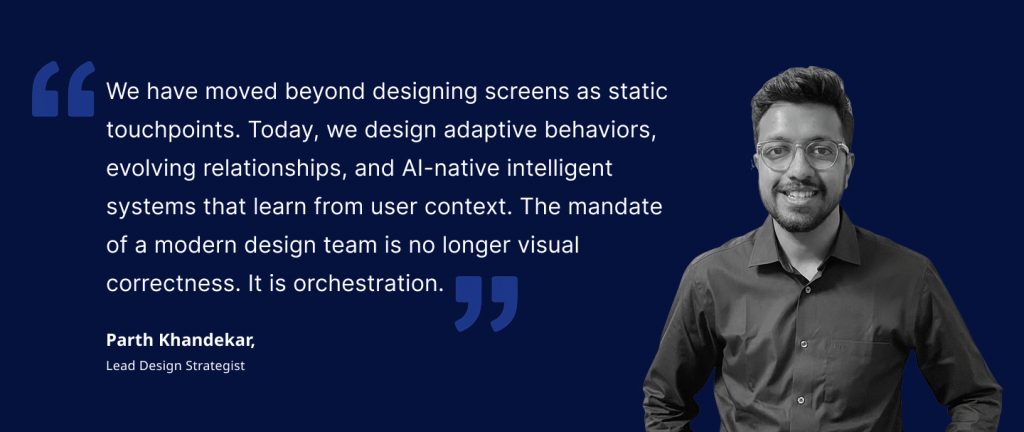
Design has shifted from screen-centric to relationship-centric. Context compounds over time rather than resetting with every session. AI-native experiences are built on conversational journeys, voice-first interactions, and prompt-driven thinking, all grounded in outcome-based design and human validation. The companies building for this shift today are the ones customers will choose tomorrow.
The ones waiting to see how it plays out are running a risk they may not yet be able to measure, but their customers already can.
Robosoft Technologies
We work with enterprises across Fintech, Travel, Retail, Media & Entertainment, and others to build AI-native digital products, combining experience design, software engineering, and data and AI as an integrated discipline, driving CX transformation. If your digital CX is due for a harder look, we would like to have that conversation.